Census Management Software Guide for Senior Living: Census Data Tools, Census Bureau Data Resources, Integration and Data Management in 2026
Census management software helps a senior living community see its census, find out why it moves, and act before an empty room turns into an empty wing. I built Census Mastery because the owners I worked with had plenty of census data and no idea what to do with it on Monday morning.
This guide explains what the software category covers, which data tools matter, what it costs and how to pick one. Facts were checked on October 20, 2026.
What is census management software?
Census management software is any platform a senior living operator uses to track occupancy, inquiries, tours, move-ins and move-outs, and the reasons behind each one. Some products count beds. Better ones show why the count changes: lead flow, reviews, Google rank and competitors. In senior care, census simply means how many residents you serve today.
A quick note on the word, because Google mixes it up. When you search for census software, you also get the U.S. Census Bureau, the American Community Survey and data tools like data.census.gov. Those are government statistics. They are useful to you, and I will show you how, but they are not the software that runs your census.
In senior living, the census management system usually lives in one of three places:
- Your EHR or care platform. Tracks who is in which room, billing and care levels.
- Your senior living CRM. Tracks inquiries, tours and move-ins. See our senior living CRM guide, or a senior living CRM with follow-up reminders inside Census Mastery.
- Census growth software. Tracks what families see before they call: reviews, Google Maps rank, directories and AI answers. This is where Census Mastery sits.
Why census data matters more in 2026
Census data matters because demand is strong and the gap between full and half-full communities is now local. National assisted living occupancy reached 89.1 percent in the third quarter of 2026, up from 88.3 percent, per the NIC release of October 1, 2026.
Senior housing as a whole hit 90.4 percent. So if your building sits at 75 percent, the market is not the problem. Something families see about you is.
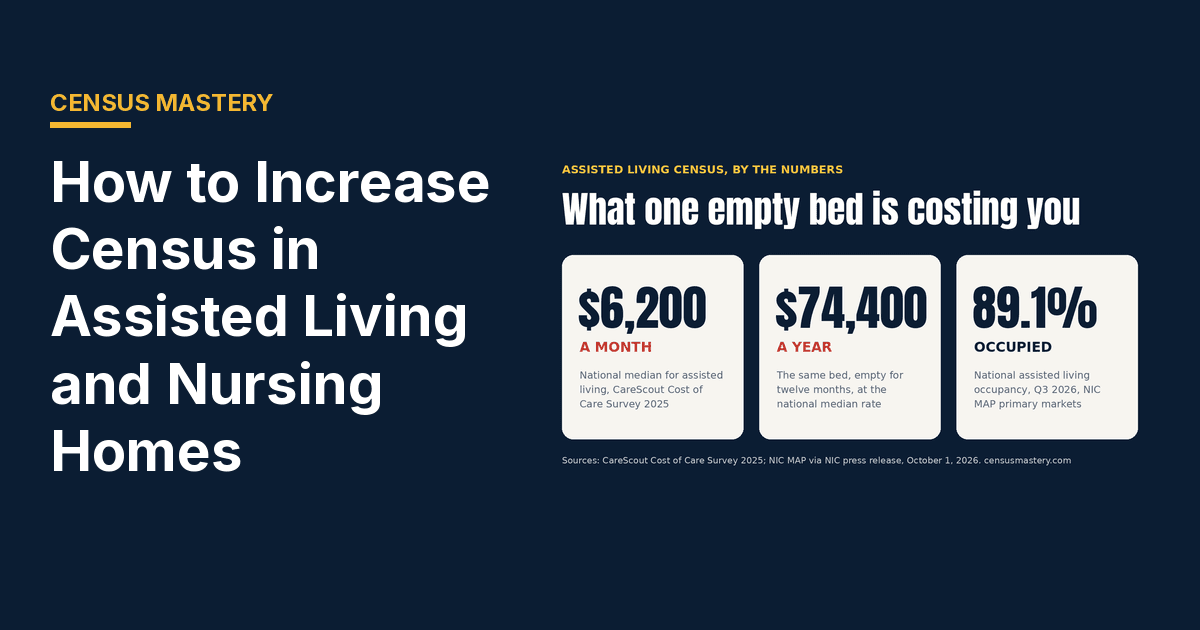
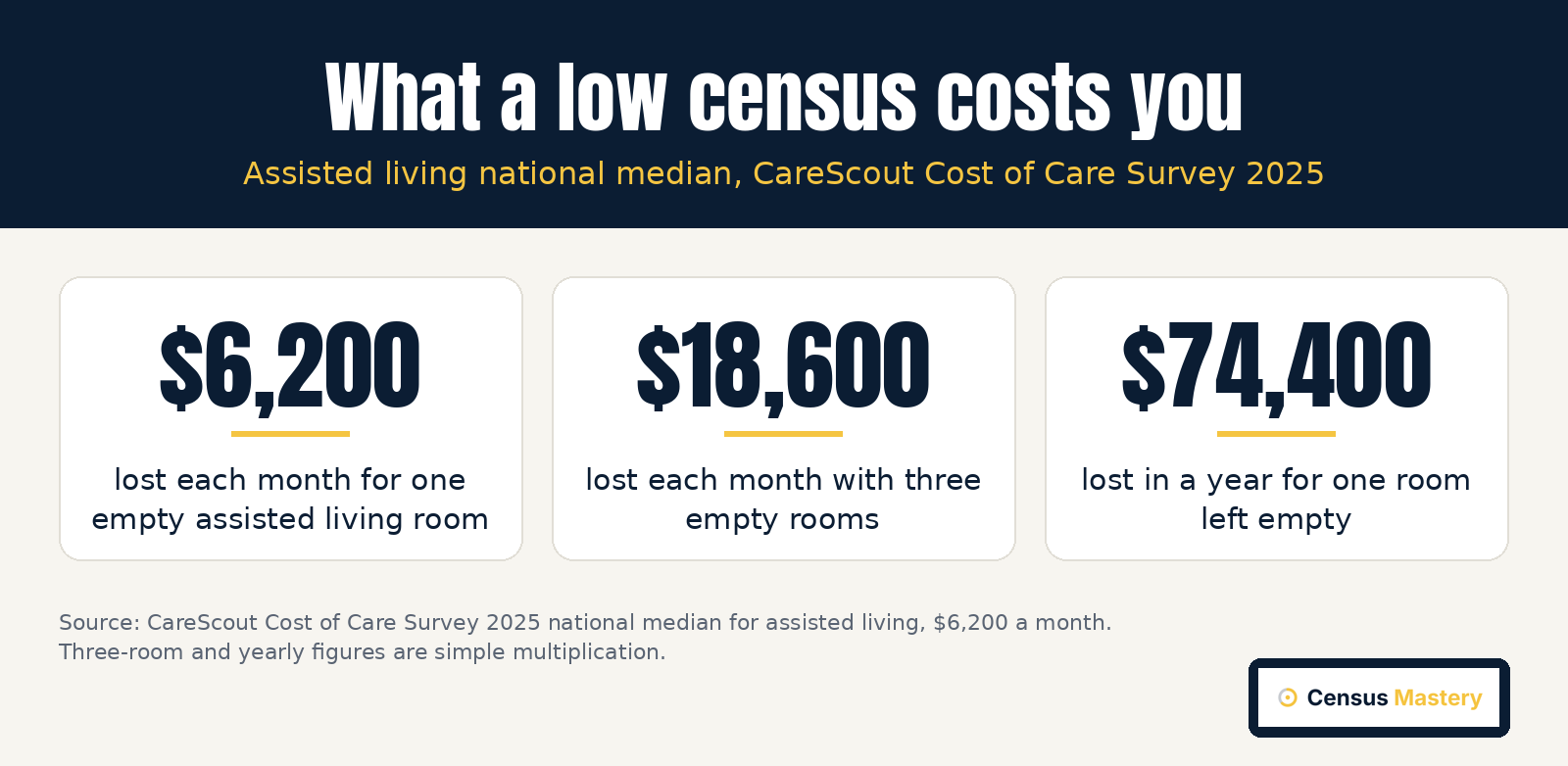
The money makes it urgent. The national median for assisted living is $6,200 a month, or $74,400 a year, per the CareScout Cost of Care Survey 2025. Three empty rooms cost you about $18,600 every month. That is the number I put at the top of every census report.
And the line of future residents keeps growing. The U.S. population age 65 and older rose 3.1 percent to 61.2 million in 2024, according to the Census Bureau's Vintage 2024 estimates, released June 26, 2025.
How to use Census Bureau survey data and data tools for your market
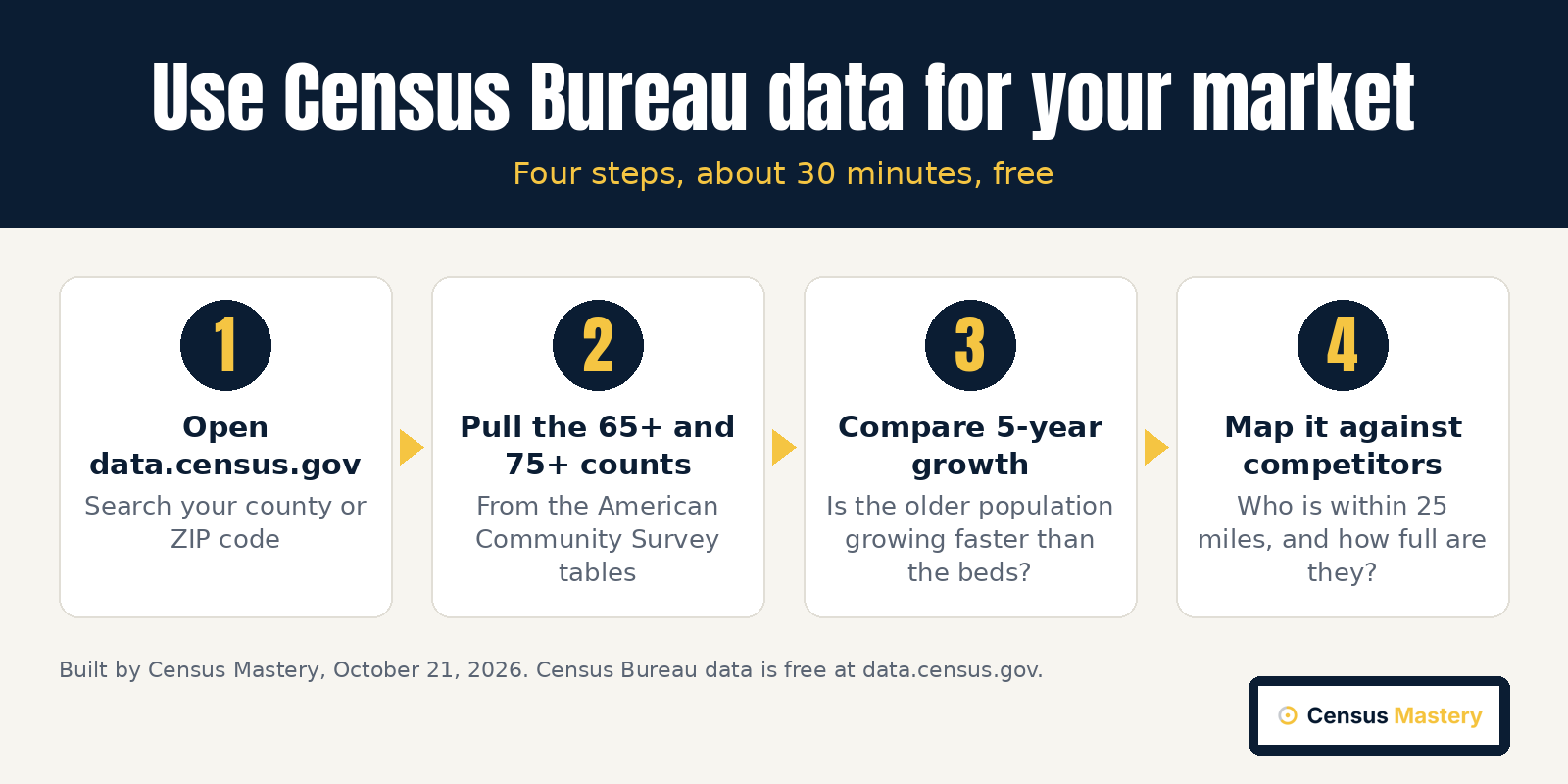
Free census bureau data tells you how many older adults live near you and how fast that number is growing. Pull county numbers from data.census.gov or the American Community Survey (ACS), then compare them to your occupancy. If your county is aging fast and your census is flat, your problem is visibility, not demand.
Here is the simple version I give owners:
- Download the age table for your county and nearby zip codes from data.census.gov.
- Look at the trend. Is the 75 and older group growing? That is your future demand.
- Map it against competitors. Where are the other communities, and how many reviews do they have?
- Write down one number. Older adults per licensed bed in your area. Watch it each year.
You do not need research guides or a statistics software package built for analysts. A spreadsheet works. The census bureau conducts the surveys, from the decennial count to the ACS and its business surveys, and publishes the dataset with metadata for every geographic level. Your job is to read the one or two tables that matter for your town, then visualize them next to your own census.
The Census Bureau's data resources also serve state and local government planners, so the county tables are well kept. Treat them as free market research, not as administrative software.
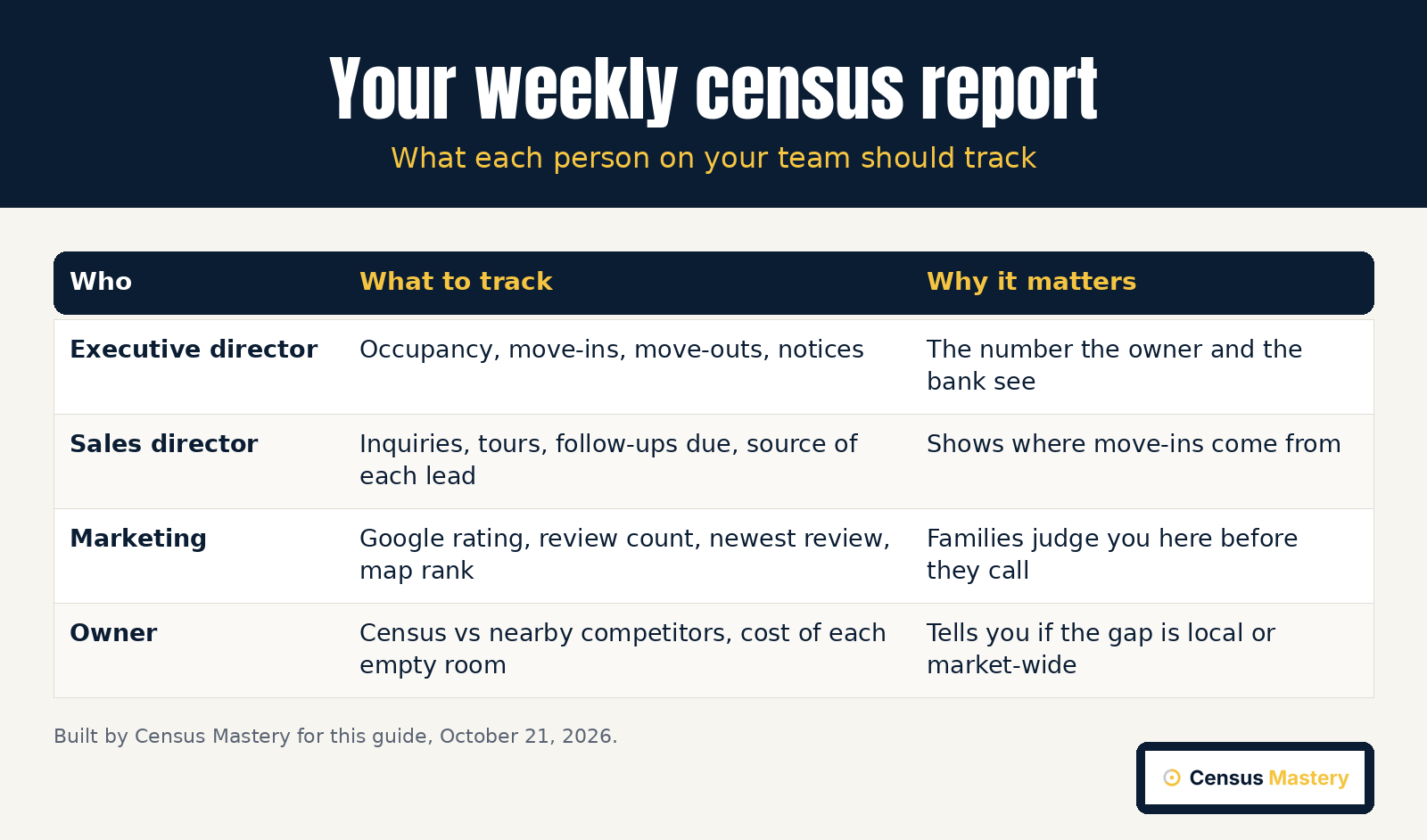
Census data collection: what each user on your team should track
Every user who touches a family should log the same few facts: the inquiry date, the source, the care need, the tour date and the outcome. Good data collection is boring and consistent. When the front desk, the sales director and the administrator all record it the same way, your census data finally explains itself.
- Front desk: source of every call and walk-in.
- Sales lead: tour date, follow-up date and outcome.
- Administrator: move-ins, move-outs and the reason for each.
- Owner: one weekly look at the trend.
This is data management, not paperwork. Software based tools make it faster, but the habit matters more than the brand.
The five jobs good census management software should do
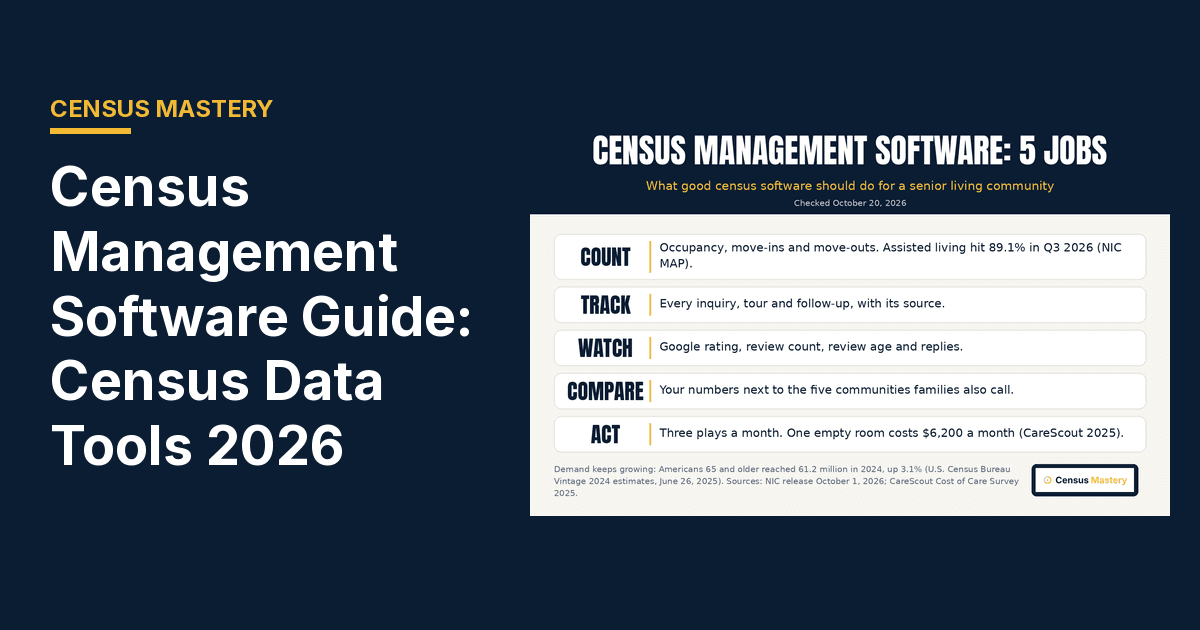
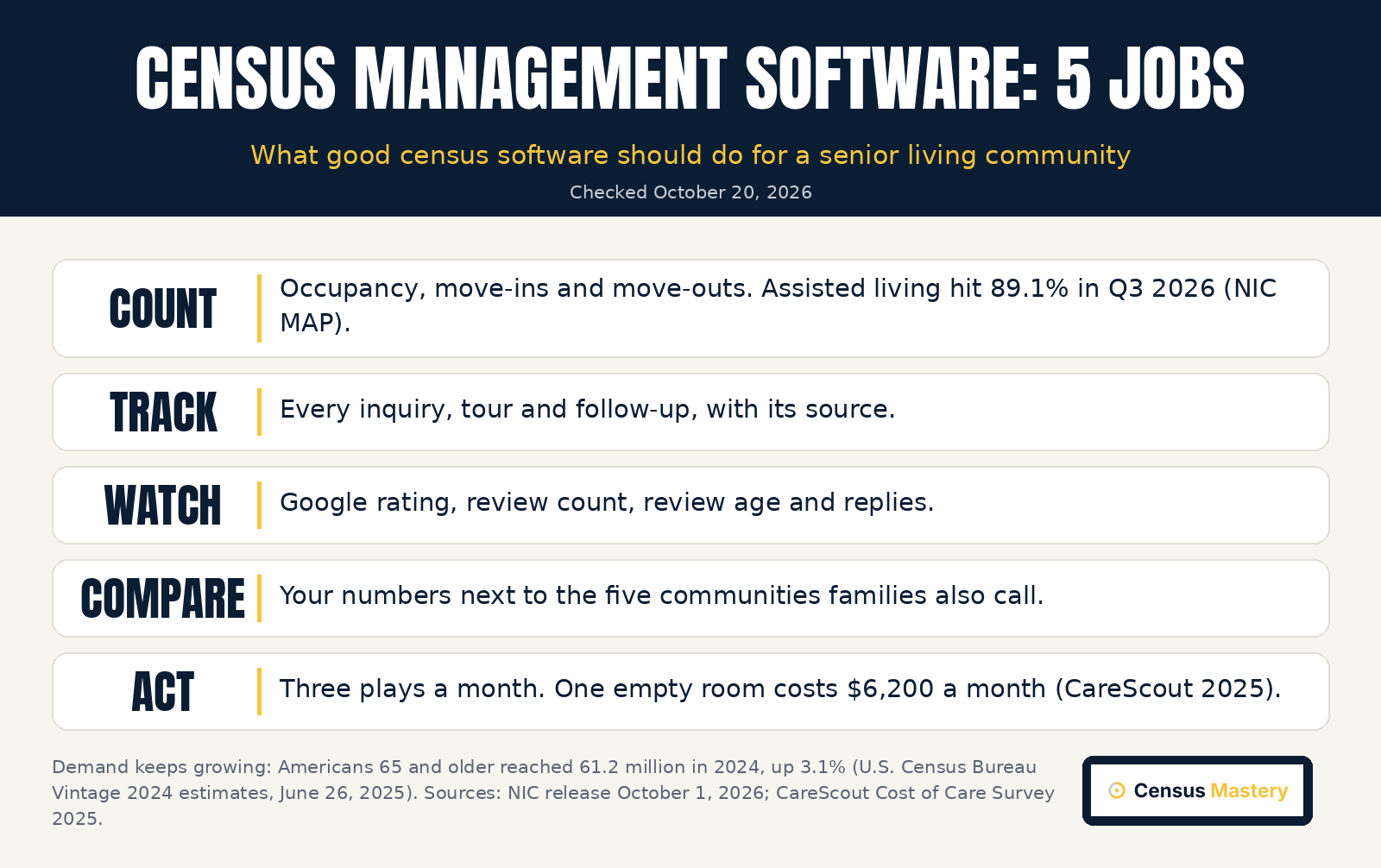
Good census management software does five jobs: it counts occupancy, tracks every inquiry to move-in, shows what families see online, compares you to competitors and tells you what to do next. Most platforms do one or two. Few do all five, so most operators combine a care platform, a CRM and a visibility tool.
- Count. Occupied units, move-ins, move-outs and the trend over time.
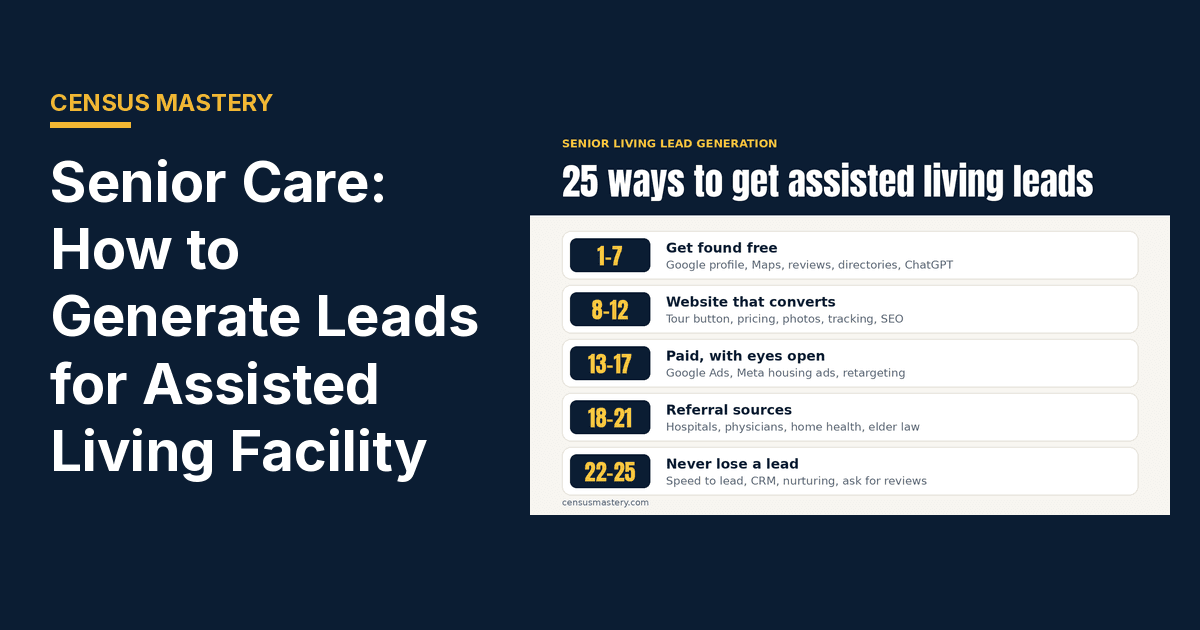
- Track leads. Every inquiry, tour and follow-up, with the source. Read how to generate leads for an assisted living facility.
- Watch reputation. Google rating, review count, review age and replies.
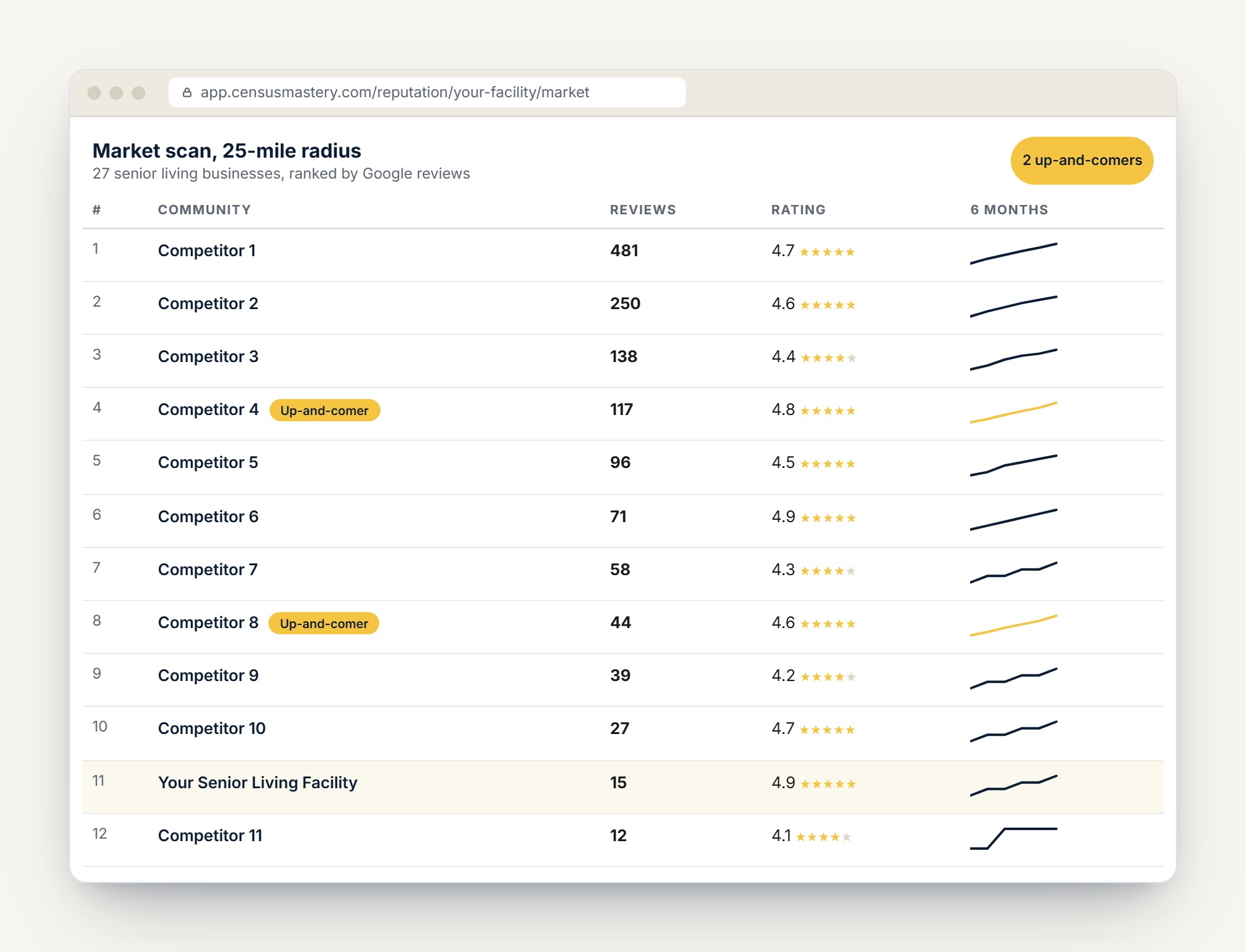
- Compare. Your numbers next to the five communities families also call.
- Recommend. A short list of actions for this month.
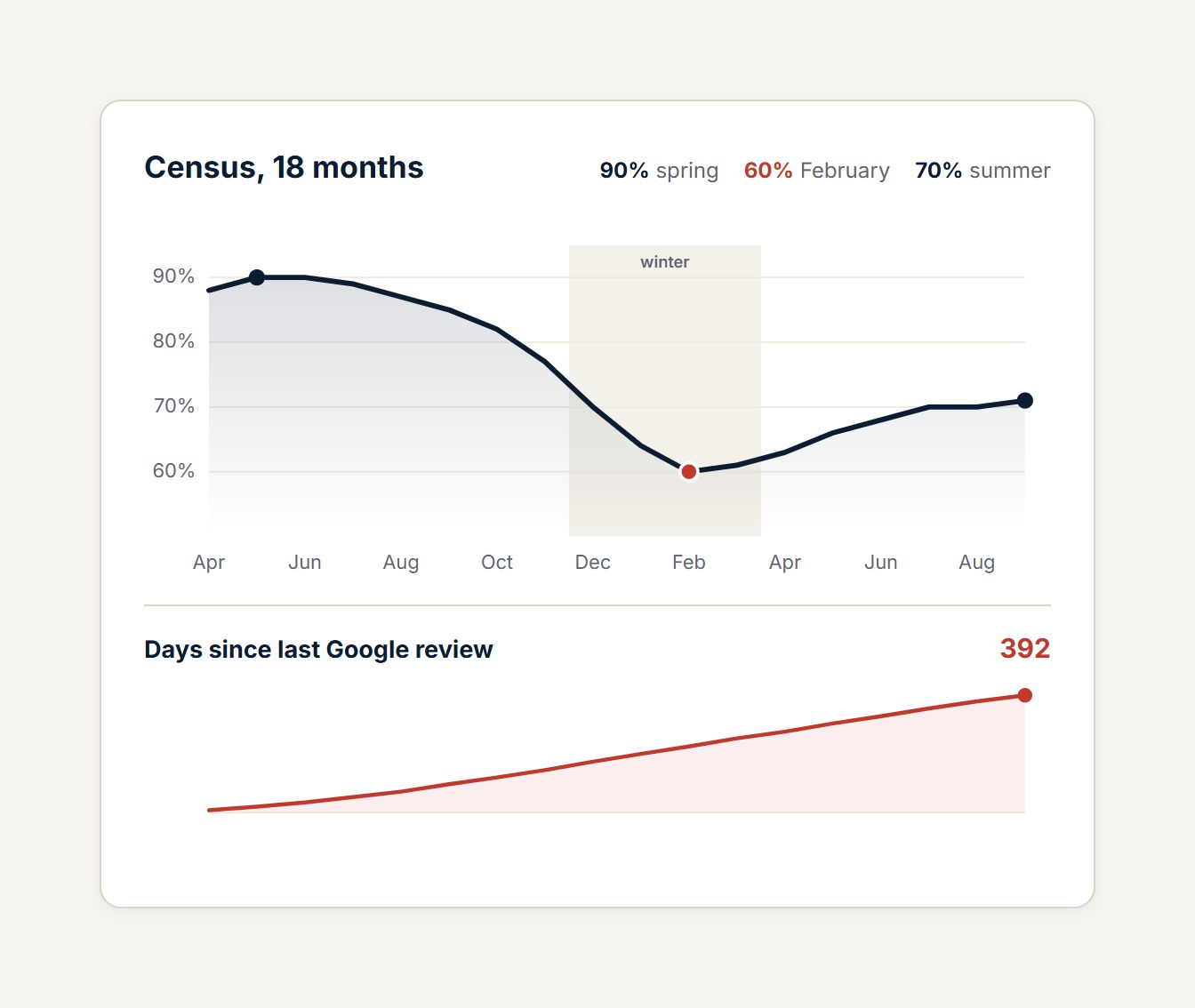
The chart above is the pattern I see most. Census slides for months while the newest Google review gets older. Families read that. In the BrightLocal Local Consumer Review Survey 2026, 97 percent of consumers read reviews, 32 percent want a review from the last two weeks, and 45 percent now use AI tools for local recommendations.
Census management software features and capability to compare
Compare census management software on data, integration and the actions it gives you. Ask what it imports and exports, whether it connects to your CRM or EHR, how it handles privacy and personal data, and whether a busy administrator can use it in ten minutes a week. A dashboard nobody opens does not change census.
| Capability | Why it matters | Questions to ask the vendor |
|---|---|---|
| Occupancy and trend reports | Shows the swing before it hurts | Can I see 12 to 18 months at a glance? |
| Lead and source tracking | Shows which channel brings move-ins | Does every inquiry carry a source? |
| Review and listing monitoring | Families judge you here first | Which sites? Google, Caring.com, A Place for Mom? |
| Competitor comparison | Census is relative to the next community | Who picks the competitors? |
| Google Maps rank | Most families start with a map search | How many search terms, how often? |
| AI search visibility | ChatGPT and Gemini now recommend communities | Which engines are checked? |
| Import and export | Your data stays yours | CSV import and export? |
| Privacy | No resident health information where it does not belong | What data do you store? |
| Customization | Your stages and care levels, not a generic pipeline | Can I rename stages and fields? |
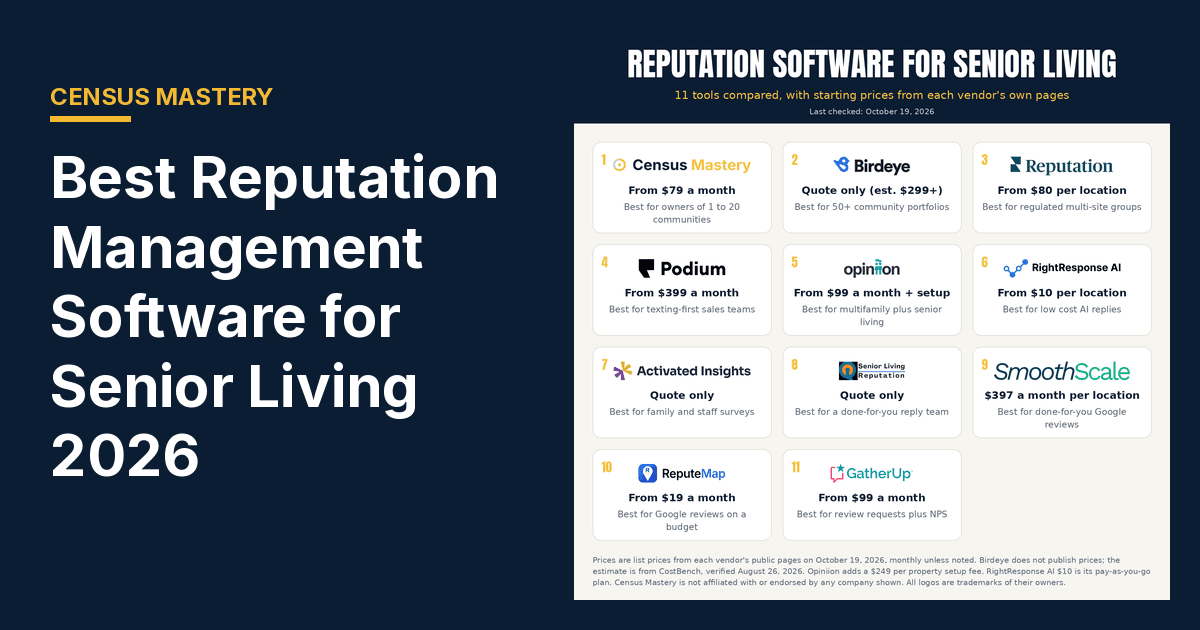
If you are comparing vendor categories rather than features, our best senior living census software list ranks the tools, and the assisted living CRM software buyer's guide covers EHR and CRM platforms.
How census management software and reputation work together
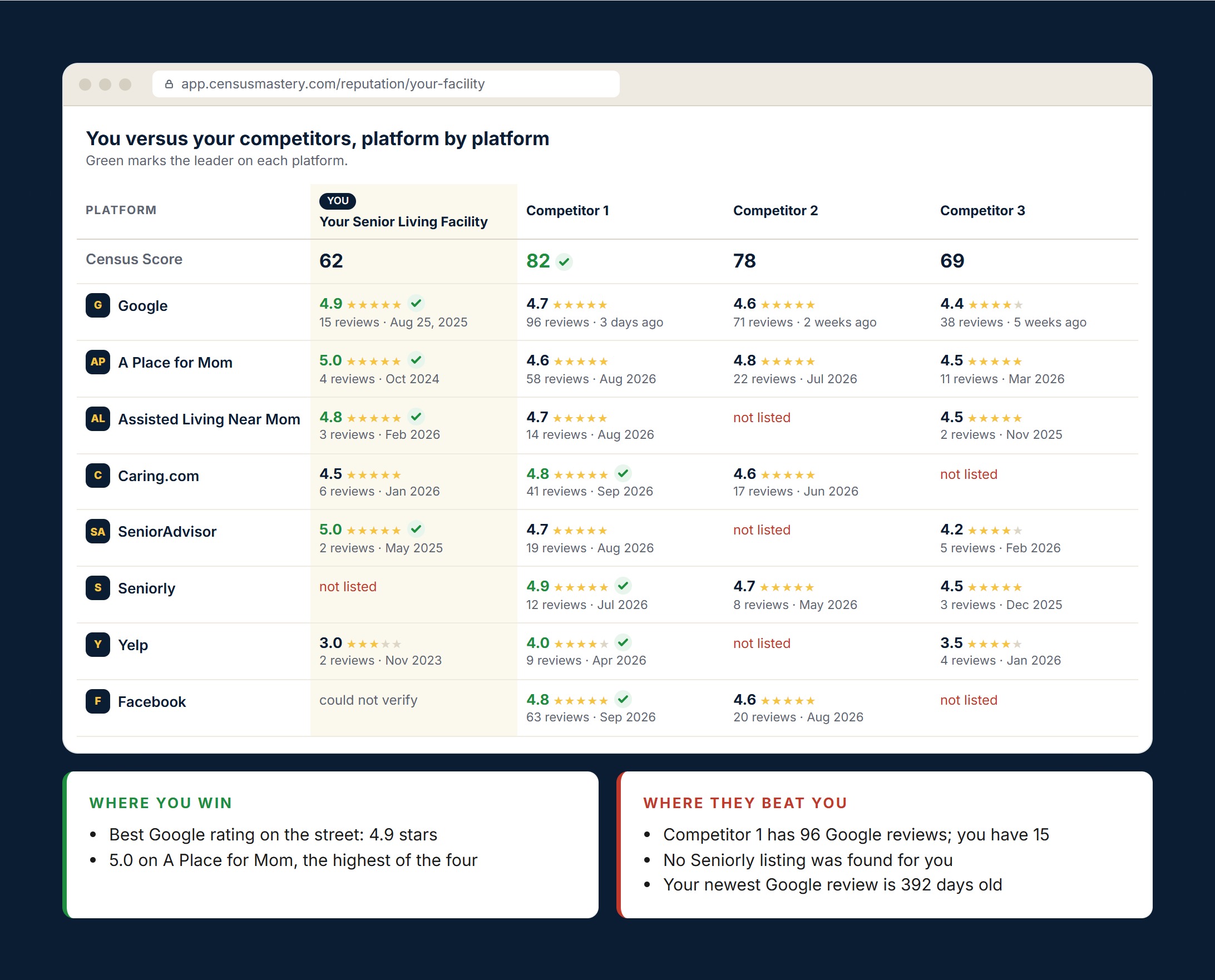
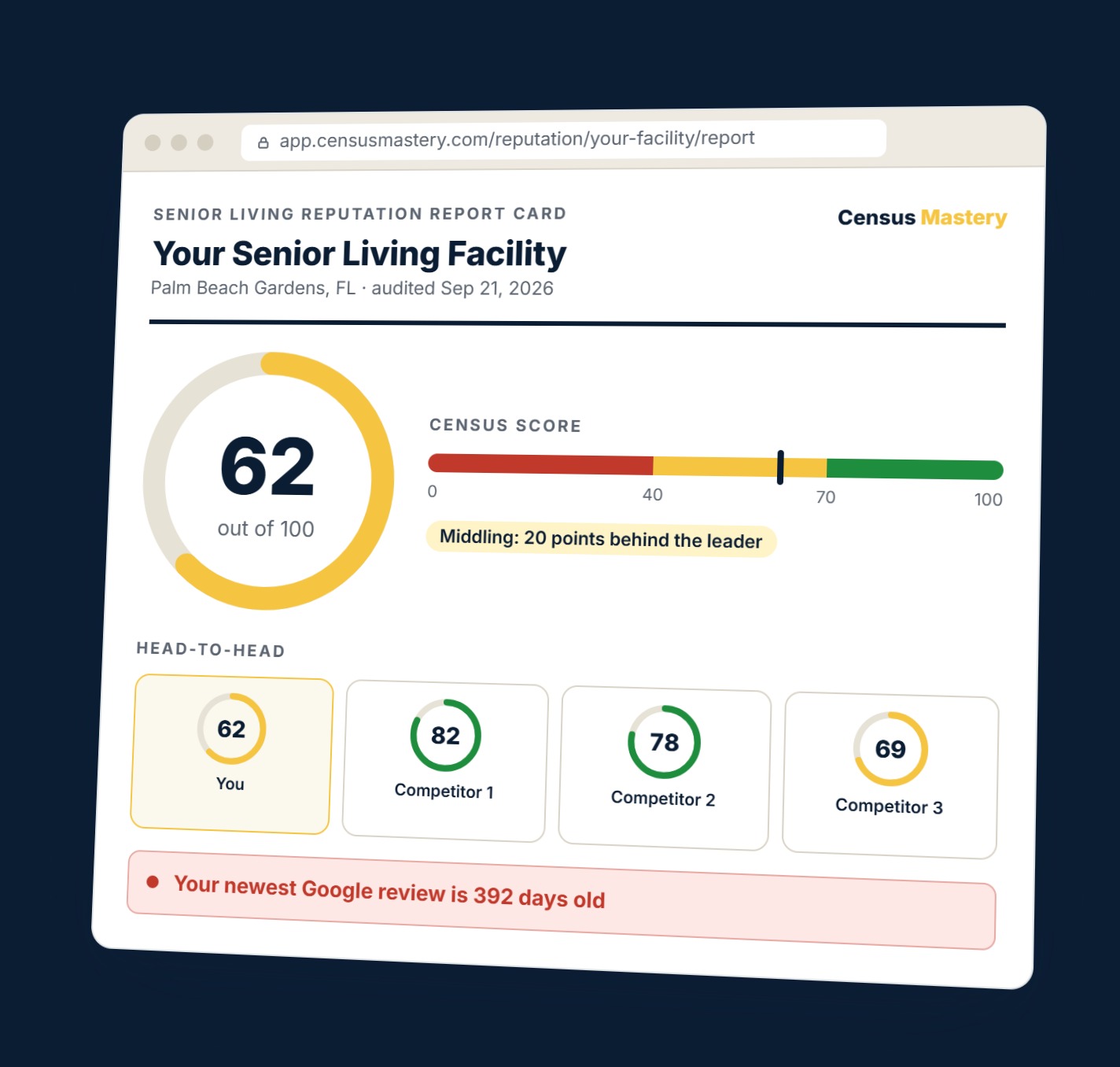
Census follows reputation. A family shortlists communities from Google, directories and now AI answers before they ever call. If your rating is 4.1 and the community down the road is 4.8, the census software in your back office will record the loss but never explain it. Reputation data explains it.
That is why Census Mastery is built around a Census Score out of 100, made from seven measures: Google rating, review count against competitors, age of your newest review, directory coverage, directory rating, owner reply rate and a clean page one for your name. It scans 150 plus directories and puts you next to five competitors.
For the buyer's view, read how to choose senior living reputation management software. For the whole loop in one place, see senior living reputation management, then our senior living reputation management page.
What census management software costs
Prices range from free spreadsheets to enterprise contracts. Care and EHR platforms with census modules usually sell by quote. Senior living CRMs start at $550 per community a month for WelcomeHome Core, per its pricing page checked October 21, 2026. Census Mastery costs $79, $147 or $297 a month, with no contracts.
| Option | Typical price | Best for |
|---|---|---|
| Spreadsheet plus Census Bureau data | Free | A single small home |
| EHR or care platform census module | Quote only | Clinical and billing census |
| Senior living CRM | From $550 per community a month (WelcomeHome Core) | Sales teams |
| Census Mastery | $79 to $297 a month (Census Mastery pricing) | Owners who need more inquiries |
Compare that with the cost of one referral. Our breakdown of how much A Place for Mom charges shows why owners look for steadier sources of move-ins.
How to choose census software for your community
Pick census software by the problem you have. If you cannot see your occupancy clearly, fix the care platform. If inquiries go cold, fix your CRM and follow-up. If inquiries are thin, fix visibility: reviews, Google Maps rank, directories and AI answers. Most small operators have the third problem first.
- Write your current census and your target. Example: 31 of 40 rooms, target 37.
- Count last month's inquiries and tours. Under a dozen inquiries means visibility.
- Check your Google rating and newest review date. Older than 30 days is a warning.
- Ask each vendor for a demo with your own community. Sample data proves nothing.
- Set one owner and one weekly review. Software does not move census; people do.
Our guide on how to increase census in assisted living has 21 plays you can run this month, and how to market an assisted living facility puts them into a full plan.
Frequently asked questions
These are the questions owners and administrators ask me most about census software. Prices and features come from vendor pages checked on October 19 and 20, 2026, and statistics come from NIC MAP, CareScout, BrightLocal and the U.S. Census Bureau. Ask any vendor for a written quote before you buy.
What does census mean in healthcare?
In healthcare and senior care, census means the number of patients or residents a facility serves on a given day. Occupancy is census divided by available units or beds. A 40-room community with 34 residents has a census of 34 and an occupancy rate of 85 percent.
Is census management software free?
Some options are. A spreadsheet plus free census bureau data from data.census.gov costs nothing. HubSpot and Zoho offer free CRM tiers for small teams. Senior living platforms usually charge a monthly fee per community, and many sell by quote.
What is the best source for population data?
The U.S. Census Bureau is the primary source. The American Community Survey gives yearly demographic data by county and zip code, and the annual Population Estimates track the 65 and older group. Use data.census.gov to get data for free.
Which census management software is best?
The best one solves your biggest gap. For bed and billing census, use your EHR. For sales, a senior living CRM. For more inquiries, a visibility platform such as Census Mastery. Many operators use two together.
The bottom line
Census management software is only worth it if it changes what you do this week. Count your beds, track every inquiry, and fix what families see before they call. That last part is where most census is won or lost.
Census Mastery comes with a guarantee. We guarantee a move-in. See the guarantee, then get your free Census Score on a 20-minute call to see where your community stands.
Keep reading: get a free senior living competitor analysis and see our senior living review software.