How Much Does A Place for Mom Charge Communities? Referral Fees Explained
How Much Does A Place for Mom Charge Communities? Referral Fees Explained
A Place for Mom (APFM) is free to families searching for assisted living for a loved one. Assisted living communities pay the bill. If you own or run a community, the fee for one move-in can equal most or all of a resident's first month of rent and care, and sometimes more than $12,000 for memory care.
This guide explains how much APFM charges, how the fee works, what it means for the cost of assisted living, and how to decide if the math works for your community. We used APFM's own words, sworn hearing testimony and national cost data, all checked on October 19, 2026.
How much does A Place for Mom charge? The short answer on senior care referral fees
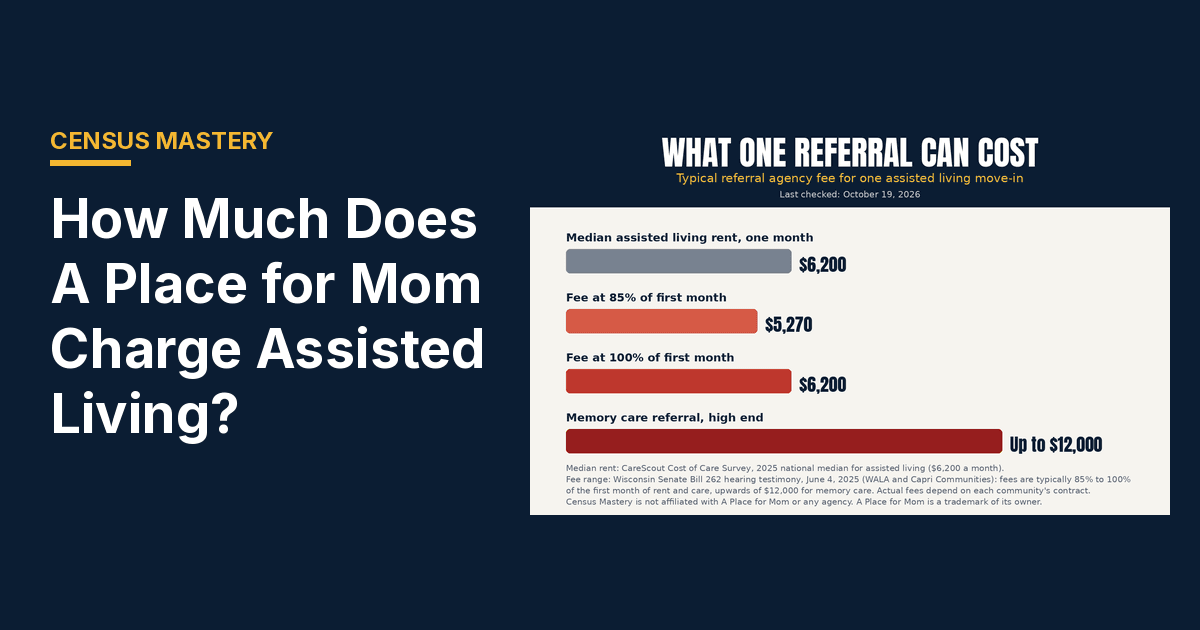
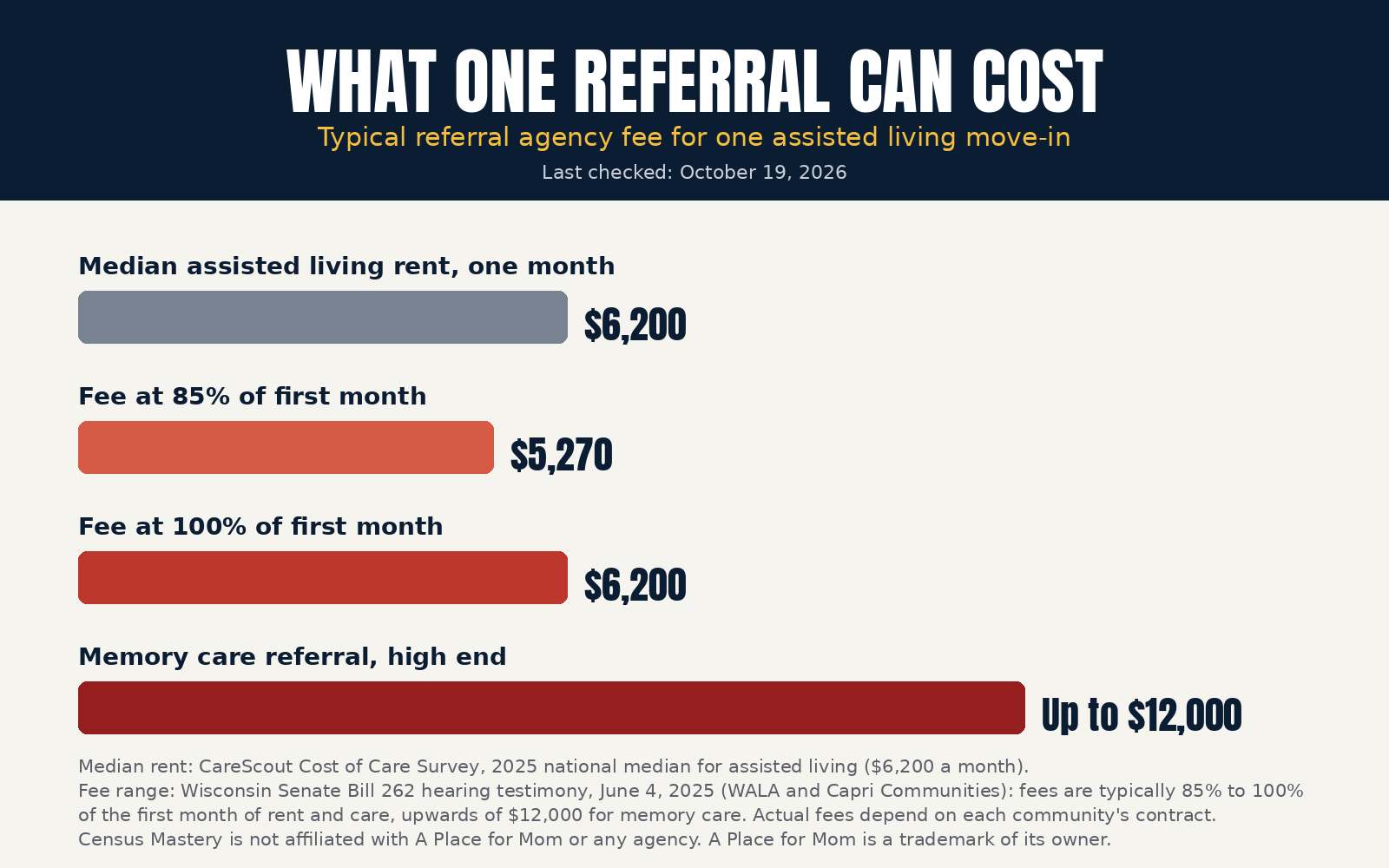
A Place for Mom does not publish its fee. Testimony from Wisconsin operators at a June 2025 hearing says referral agency fees are typically 85% to 100% of a resident's first month of rent and care. That equals about $5,270 to $6,200 at the national median assisted living cost.
Here is what we could confirm, and from where:
| Question | Answer | Source |
|---|---|---|
| Do families pay A Place for Mom? | ❌ No. "Our personalized guidance is free to our families." | A Place for Mom |
| Who pays? | ✅ Participating communities and home care providers, when a family moves in or signs up | A Place for Mom |
| When is the fee due? | Only after a move-in; A Place for Mom calls it "a success-based fee" | A Place for Mom testimony, SB 262 |
| Typical fee size | 85% to 100% of the first month of rent and care (operator testimony, an estimate, not a published price) | WALA and Capri Communities testimony, SB 262 |
| Dollar range per resident | $4,800 to $7,200; $9,000 to $12,000 for memory care (estimate) | Capri Communities testimony, SB 262 |
| How long a lead counts | "Generally capped at two years," says A Place for Mom | A Place for Mom testimony, SB 262 |
| Contract terms | Cancelable "with just 30 days' notice," says A Place for Mom | A Place for Mom testimony, SB 262 |
Last checked: October 19, 2026. APFM is a trademark of its owner. Census Mastery is not affiliated with, sponsored by or endorsed by APFM. Fee ranges are estimates from public hearing testimony, not prices published by A Place for Mom. Your contract is the only source for your real fee.
How A Place for Mom makes money from senior living communities
APFM makes money from referral fees. Communities in its network pay when a family the company referred moves in. The company says families pay nothing and that its advisors "are not compensated based on which community in our network you choose." Communities outside the network get no referrals.
On its own site, APFM says: "We're paid by our participating communities if a family member moves into a senior living community or signs up with a home care provider." Its footer repeats it: "A Place for Mom is paid by our participating communities, therefore our service is offered at no charge to families."
In June 2025 testimony to the Wisconsin Senate health committee, A Place for Mom's counsel described the process. When a family agrees to referrals, the company contacts the community to check whether the family already knows it. Communities pay "only if a family moves into a referred community." The company says more than 40,000 Wisconsin families used it in 2024, at no cost to them.
That model is simple, and it is why families seeking senior housing or care services like it. A loved one's needs are complex, and a free advisor helps. The cost of care is still paid by someone, and that someone is the senior living community.
What the fee looks like for one move-in: average cost of assisted living compared
For one assisted living move-in, a fee of 85% to 100% of the first month equals $5,270 to $6,200 at the CareScout 2025 national median of $6,200 a month. Memory care fees run higher because rent and care cost more. One Wisconsin operator testified to fees of $9,000 to $12,000.
The CareScout Cost of Care Survey puts the national median monthly cost of assisted living at $6,200 in 2025, up 5% from $5,900 in 2024. That is $74,400 a year. The national average cost differs by source, but the median is a fair guide. Your community's monthly fee, level of care and care needs decide your real fee.
| Monthly rent and care | Fee at 85% | Fee at 100% |
|---|---|---|
| $4,500 | $3,825 | $4,500 |
| $6,200 (2025 national median) | $5,270 | $6,200 |
| $8,000 | $6,800 | $8,000 |
| $10,000 (memory care) | $8,500 | $10,000 |
Last checked: October 19, 2026. Illustrative math using the 85% to 100% range from public testimony; it is not a quote from any agency.
Geri Krupp-Gordon, chief operating officer of Capri Communities, which runs 43 communities in Wisconsin, testified that fees "can range anywhere from $4,800 - $7,200 per resident but can be higher if a resident requires memory care services; upwards of $9,000 - $12,000." The Wisconsin Assisted Living Association said the same range "can equate to upwards of $12,000 per resident."
How much does assisted living cost families? Type of care, home care and care options
Assisted living costs families a national median of $6,200 per month in 2025, according to CareScout. Costs change with the type of care, level of care required, apartment size and state. Communities for dementia care and a higher level of care come at a higher cost. A referral agency is free to the family, but the community still pays.
National median costs for long-term care in 2025, from CareScout:
| Type of care | 2025 national median | 2024 national median |
|---|---|---|
| Assisted living community | $6,200 a month | $5,900 a month |
| Non-medical in-home care | $35 an hour | $34 an hour |
| Adult day health care | $95 a day | $100 a day |
| Nursing home, semi-private room | $9,581 a month | $9,277 a month |
| Nursing home, private room | $10,798 a month | $10,646 a month |
Last checked: October 19, 2026. Source: CareScout Cost of Care Survey. Census Mastery is not affiliated with CareScout. According to a Place for Mom's own site, its advisors know local costs and availability.
Many assisted living communities charge one all-inclusive monthly fee. Others add care fees as needs change, with different levels of care priced in tiers. The cost of independent living is usually lower because it includes fewer care services, and many seniors choose it to age in place longer. Home care and in-home care services are paid by the hour, so the amount of care decides the monthly cost. Families weigh the benefits of assisted living against those care options.
APFM also offers a Senior Living Cost Calculator on its site. An online senior living cost calculator can help families compare them to the cost of staying at home, but understanding assisted living cost details upfront helps caregivers most. Ask each community what is included in the monthly payment.
How assisted living facilities price care
Most assisted living facilities offer several levels of care. A base monthly fee covers the apartment, meals and activities, and care fees rise as needs change. It is common for an assisted living community to add charges for medication help, incontinence care or a nurse in an assisted living setting. A memory care facility usually costs more.
Residents of assisted living communities typically pay one of three ways:
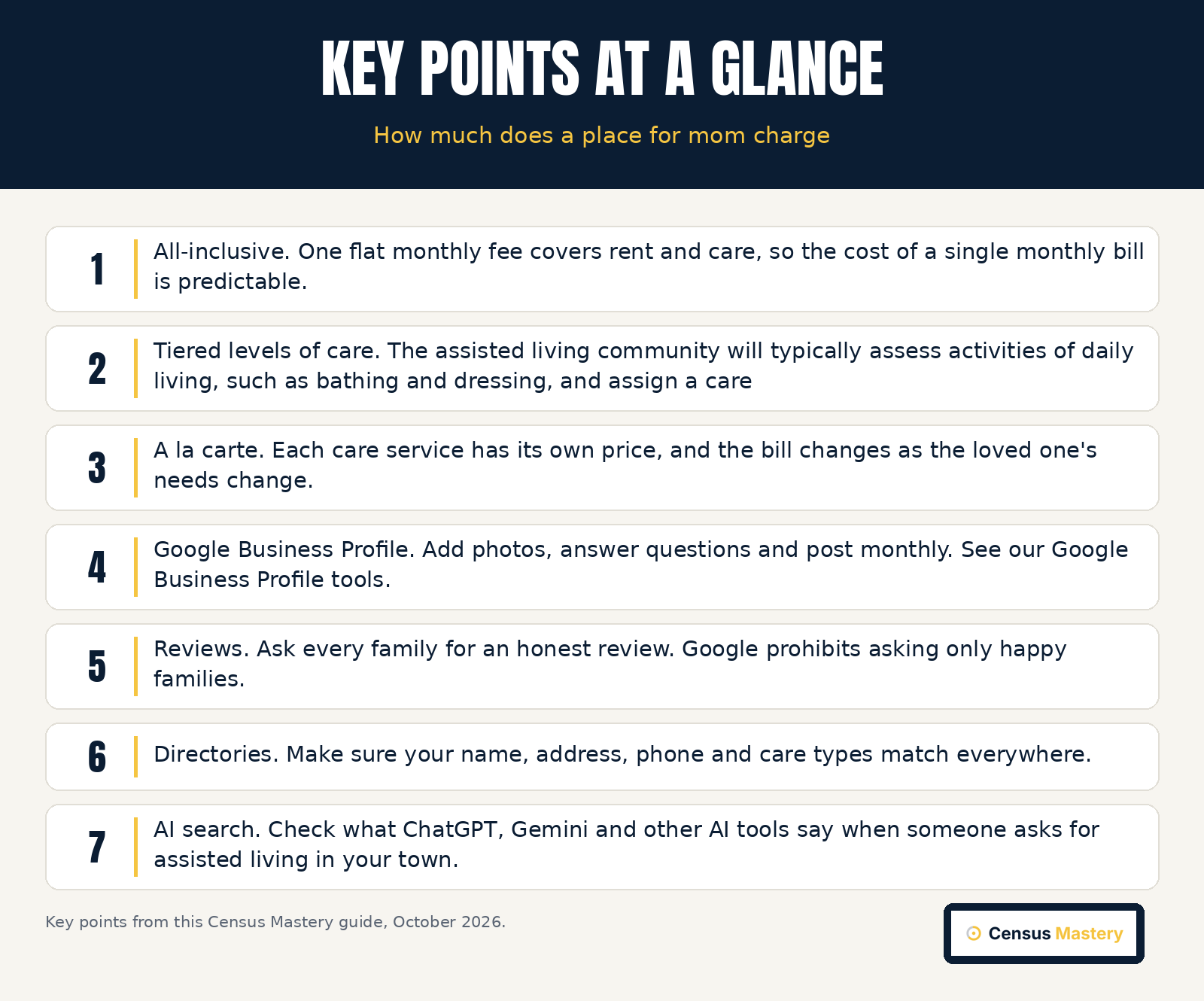
- All-inclusive. One flat monthly fee covers rent and care, so the cost of a single monthly bill is predictable.
- Tiered levels of care. The assisted living community will typically assess activities of daily living, such as bathing and dressing, and assign a care level with a set price.
- A la carte. Each care service has its own price, and the bill changes as the loved one's needs change.
For an owner, the pricing model matters for referral fees. If an agency fee is based on the first month of rent and care, a resident with a higher level of care costs you more to acquire. Ask your agency whether the fee is based on rent only or rent plus care. Families want appropriate and affordable assisted living, and the cost of living in a community should reflect care, not acquisition cost.
How families pay for assisted living matters too. Medicare does not cover room and board in assisted living. Some states have Medicaid waiver programs, and veterans may qualify for benefits. Long-term care insurance covers assisted living services under many policies. WALA noted in its testimony that referral agencies "cannot receive referral fees for prospective Medicaid residents."
Does the referral fee raise the cost of assisted living? How the cost of assisted living compares
APFM says its fee does not raise what families pay. The Wisconsin Assisted Living Association disagrees, saying the cost is "typically paid indirectly by the consumer." Both are public positions from the same June 2025 hearing. The honest answer is that it depends on how each community sets its prices.
APFM lists "Does your compensation model increase the cost of care for families?" among its own FAQs. In testimony, it argued that a bill limiting fees "risks reducing consumer choice and access," especially for smaller or rural communities.
WALA argued the opposite: "While referral agencies often advertise their services as free to prospective clients, there is usually a cost involved." WALA added that this cost is "typically paid indirectly by the consumer." Capri Communities said agencies have an incentive to refer families "to the providers that will pay the agency the most money."
If you run a community, you set your rates. A loved one moving in should not pay more because of how you market. Every dollar spent on a referral is a dollar that is not spent on staff, food or care. Across the senior living industry, referral fees from the assisted living side are one of the largest marketing costs.
The "life of lead" clause: why you may pay two years later
The "life of lead" clause lets an agency collect a fee if a family it referred moves in months or years later. A Place for Mom says its life of lead "is generally capped at two years." WALA says agencies often have "2+ years after a contract has been terminated" to collect.
APFM explained the two-year window as "based on data showing that families often begin searching for the right care setting years before they're ready to make a move."
For an owner, this is the clause to read first. A family might tour your community after finding you on Google, but if their name first came from an agency referral, you may still owe a fee. Track where every lead first came from so you can check every invoice.

Census Mastery's senior living CRM logs every inquiry, tour and move-in, and website tracking shows which visits came from Google, AI search or a directory. That record helps you match agency invoices to families who really came through the agency.
What Wisconsin's SB 262 tried to change
Wisconsin Senate Bill 262 would have required referral agencies to disclose relationships and fees and to limit fees to move-ins within one year of a referral. APFM testified against it. The bill failed to pass on March 23, 2026, according to the Wisconsin Legislature's record.
According to the bill page, SB 262 was "relating to: assisted living facility referral agencies and providing a penalty." Its history reads: "Failed to pass pursuant to Senate Joint Resolution 1" on March 23, 2026.
WALA said that other states where similar rules passed set a one-year limit. If you operate in another state, check your state's rules on senior living referral agencies before you sign or renew.
Is the fee worth it? How owners pay for assisted living marketing
A Place for Mom can be worth the fee when you have empty beds, no marketing team and a long sales cycle. It is worth less when families already find you on Google and AI tools. The question is the cost per move-in compared with what your own marketing would cost.
Where APFM is better: reach. The company calls itself the largest network of participating communities and home care providers in the U.S. Its senior living advisors talk to families by phone, help compare options and schedule tours, which helps a family find the right care when they are stressed. A small community cannot replace that overnight. APFM also notes that "even if a move-in never occurs, the community still benefits from the extensive marketing services we provide."
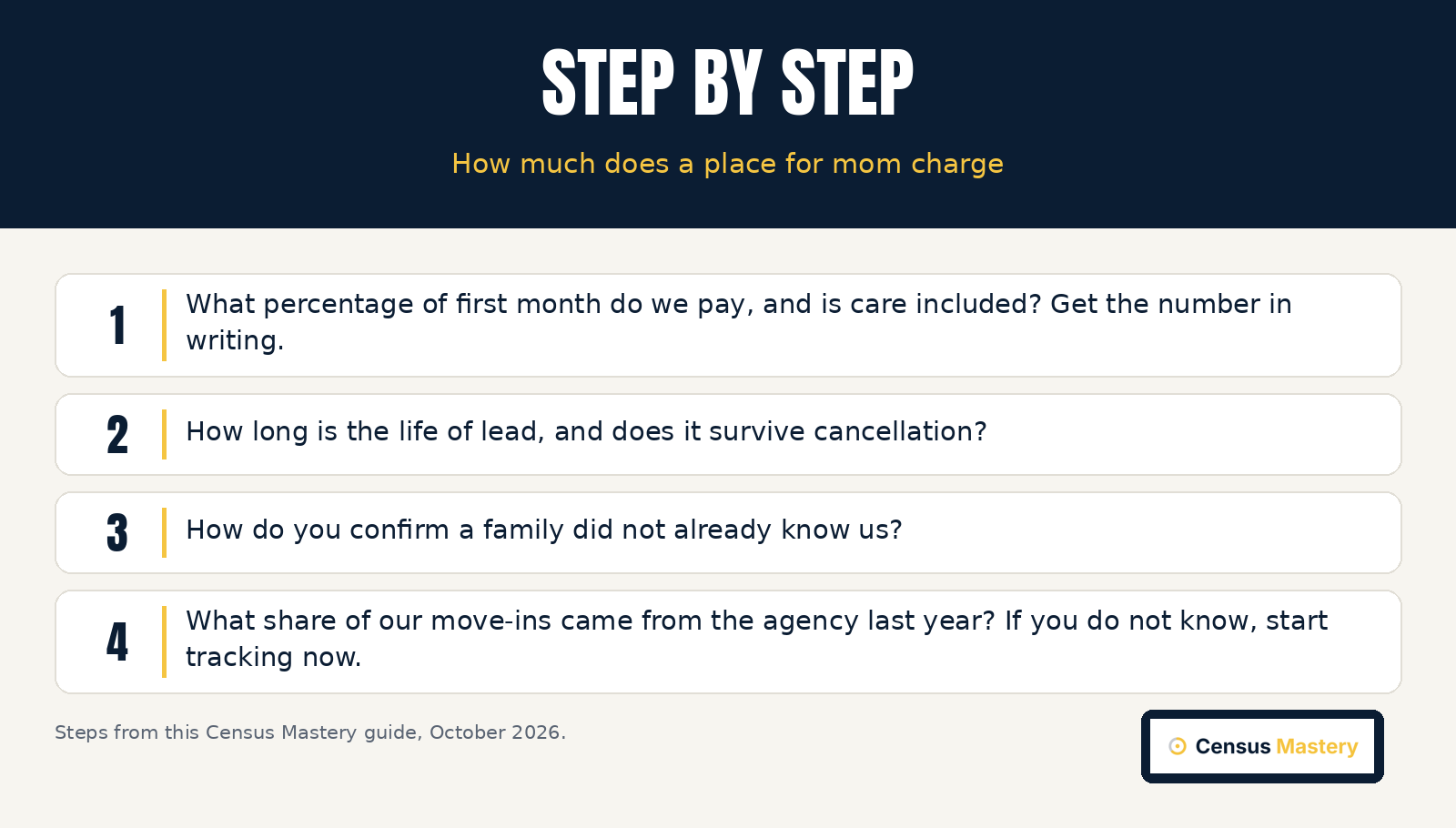
Ask these four questions before you sign or renew:
- What percentage of first month do we pay, and is care included? Get the number in writing.
- How long is the life of lead, and does it survive cancellation?
- How do you confirm a family did not already know us?
- What share of our move-ins came from the agency last year? If you do not know, start tracking now.
For a deeper look at your other options, see A Place for Mom alternatives.
How to need fewer referrals: help families find assisted living and find the right fit with you
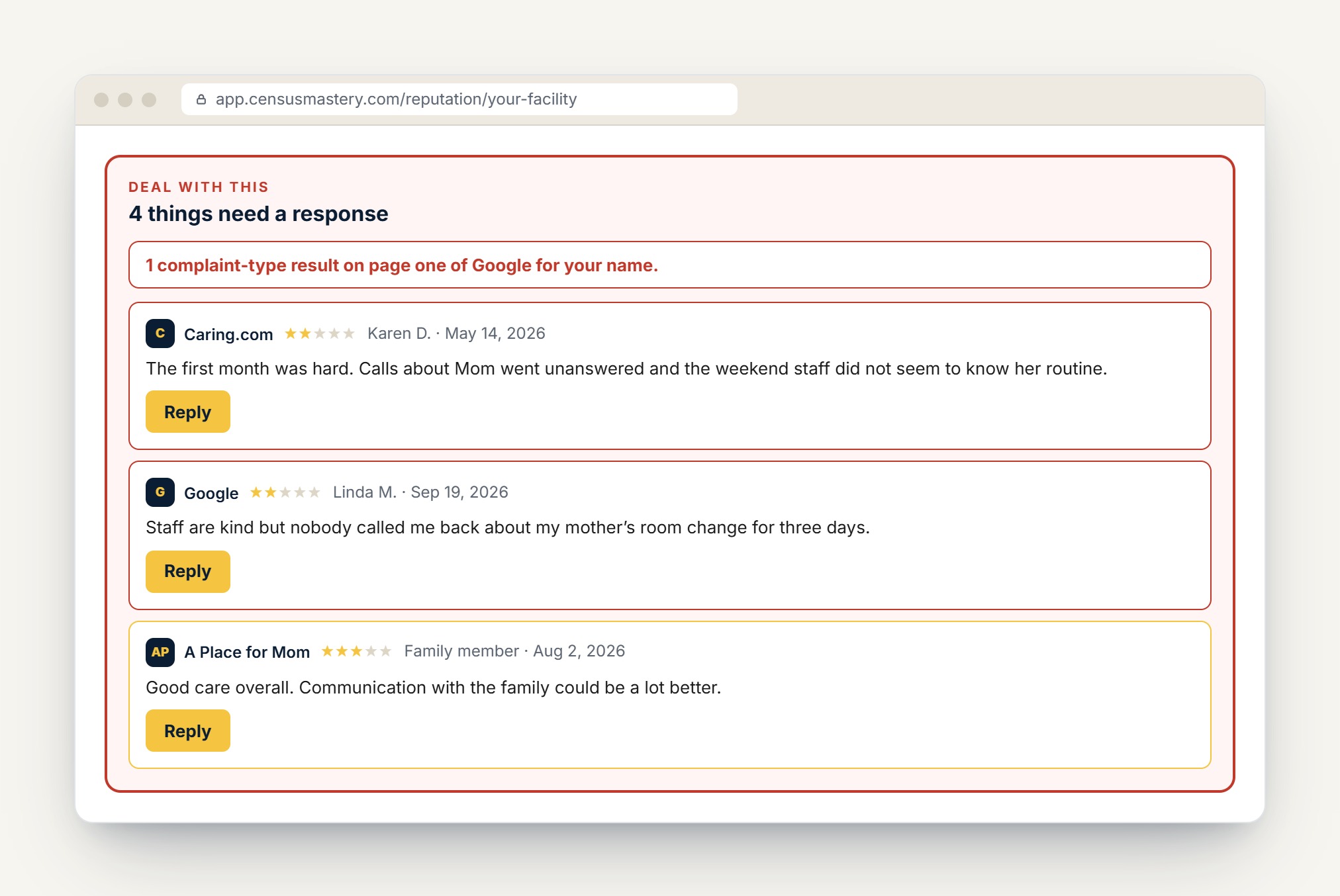
The best way to pay fewer referral fees is to make families find you first. Families looking for the right senior living option for a loved one search Google Maps, read reviews, check senior living directories and now ask ChatGPT for the best assisted living near them. Good senior living reputation management is how you show up well in those places, so more families contact you directly.
Start with the free basics:
- Google Business Profile. Add photos, answer questions and post monthly. See our senior living reputation management tools for Google Business Profile help.
- Reviews. Ask every family for an honest review. Google prohibits asking only happy families.
- Directories. Make sure your name, address, phone and care types match everywhere.
- AI search. Check what ChatGPT, Gemini and other AI tools say when someone asks for assisted living in your town.
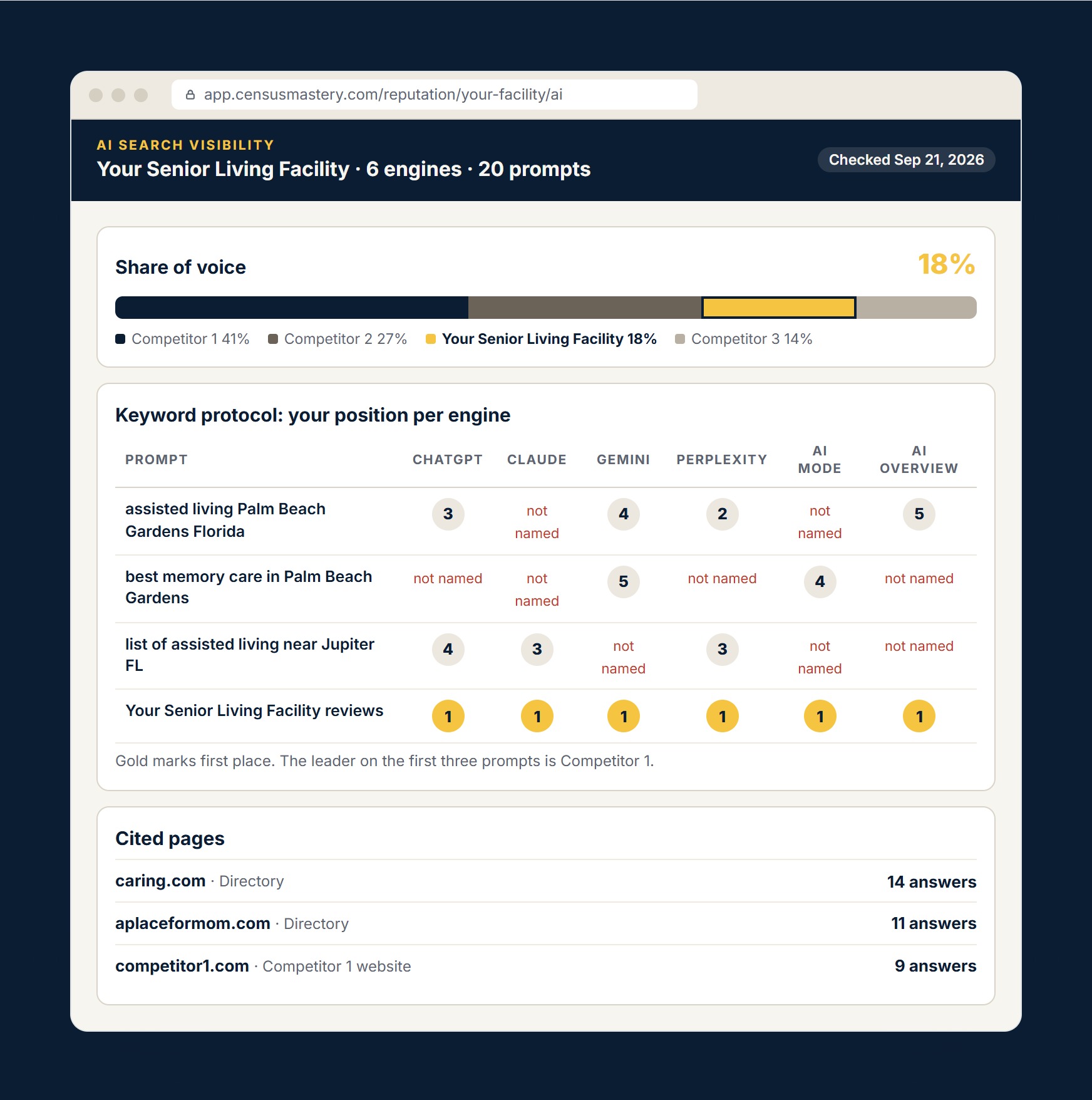
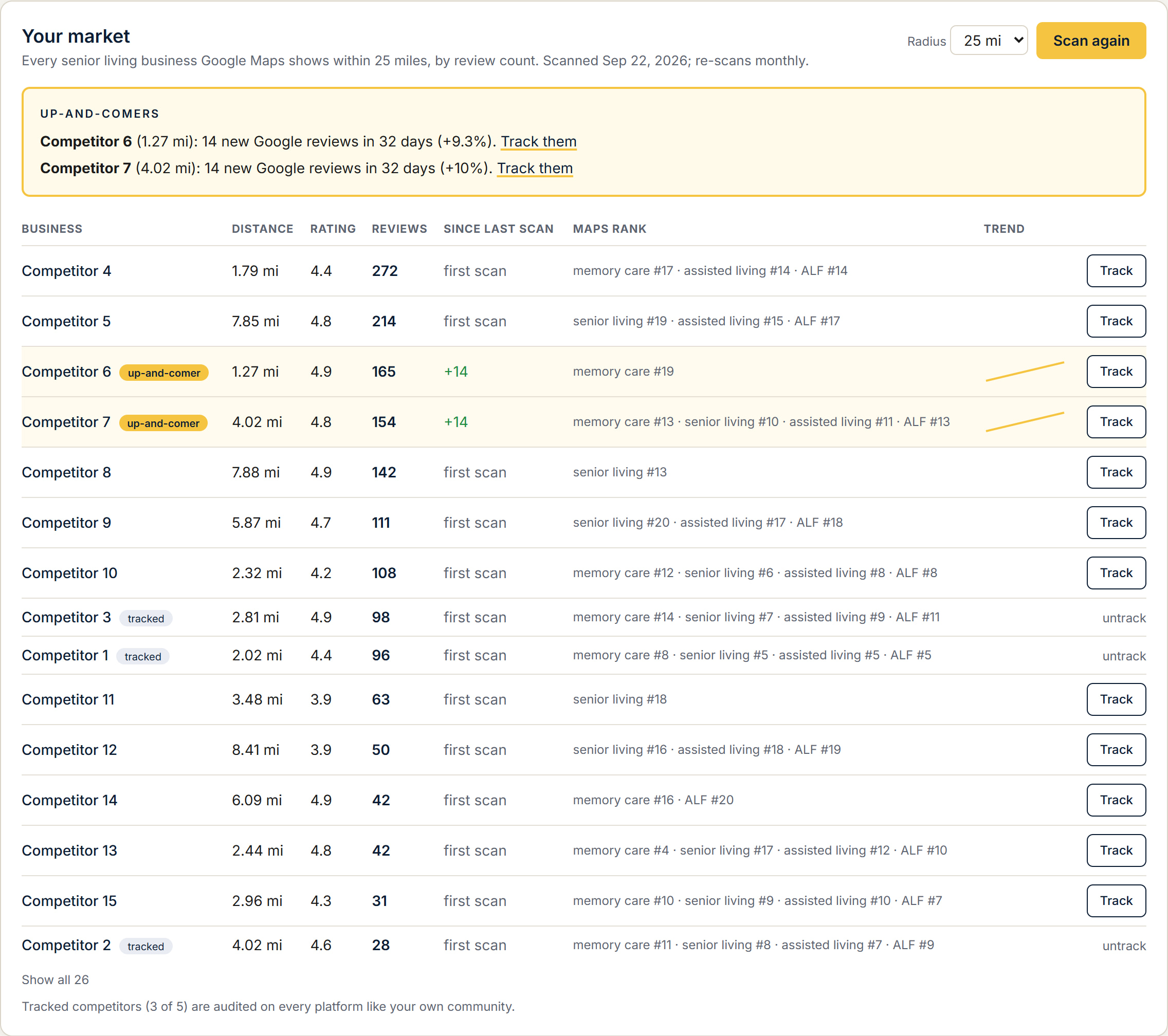
Census Mastery tracks those places for senior living owners. Census Watch is $79 a month for one community. It checks 150+ directories, tracks up to five competitors and Google Maps rank, and includes the lead pipeline. Full Census, $147 a month, adds AI search visibility across six AI engines. See Census Mastery pricing.
Full Census and Waitlist carry a guarantee: at least one move-in, or Census Mastery is free for life plus 6 months of marketing worth US$12,000. Terms apply. One avoided referral fee covers years of Census Watch.
Where Census Mastery falls short: we do not talk to families, schedule tours or send you leads. We help families find you. If you need someone to call families for you, an agency does something we do not.
Frequently asked questions
These are the questions owners and families ask most about A Place for Mom fees. Answers come from APFM's own website, public testimony to the Wisconsin Senate in June 2025 and CareScout's 2025 cost data. Fee ranges are estimates; only your contract shows your real referral fee.
Does A Place for Mom charge a fee to families?
No. APFM says its service is free to families because participating communities pay it when a family moves in. Families are not parties to its contracts with communities. A Place for Mom describes its role as "advisory, non-exclusive, cancelable at will" and optional for families.
How much does A Place for Mom charge assisted living communities?
APFM does not publish its rates. Wisconsin operators testified in 2025 that referral agency fees are typically 85% to 100% of a resident's first month of rent and care, about $4,800 to $7,200 per resident and up to $12,000 for memory care. Treat those as estimates.
Does Medicare pay for any assisted living costs?
Medicare does not pay for room and board or personal care in assisted living. It may cover some medical services a resident receives, like doctor visits. Medicaid waiver programs in many states help with care costs, and veterans benefits and long-term care insurance can help families pay.
How much does assisted living cost a month?
The national median cost of assisted living was $6,200 a month in 2025, or $74,400 a year, according to CareScout. Costs vary by state, apartment, level of care and whether the community charges one all-inclusive fee or adds care fees. Memory care costs more than standard assisted living.
Can a community cancel its A Place for Mom contract?
APFM told Wisconsin lawmakers its agreements are "voluntary and cancellable at any time, for any reason, with just 30 days' notice." Fees can still apply to families referred before you cancel, under the life of lead clause, which A Place for Mom says is generally capped at two years.
The bottom line
APFM charges communities, not families, and the fee for one move-in is often close to a full month of rent and care. Know your contract, track every lead source and build your own local search presence so more families find you first. Get your free Census Score on a 20-minute call.
Keep reading: get a free senior living competitor analysis and how to generate leads for an assisted living facility.