How to Generate Leads for Assisted Living Facility Owners: 25 Proven Lead Generation Strategies to Generate Leads for Senior Living Communities, From Online Marketing to Facebook Ads
How to Generate Leads for Assisted Living Facility Owners: 25 Proven Lead Generation Strategies to Generate Leads for Senior Living Communities, From Online Marketing to Facebook Ads
Every owner I talk to asks some version of the same question: where do I get more families calling? Not more clicks. Not more followers. More real families with a parent who needs care in the next few months.
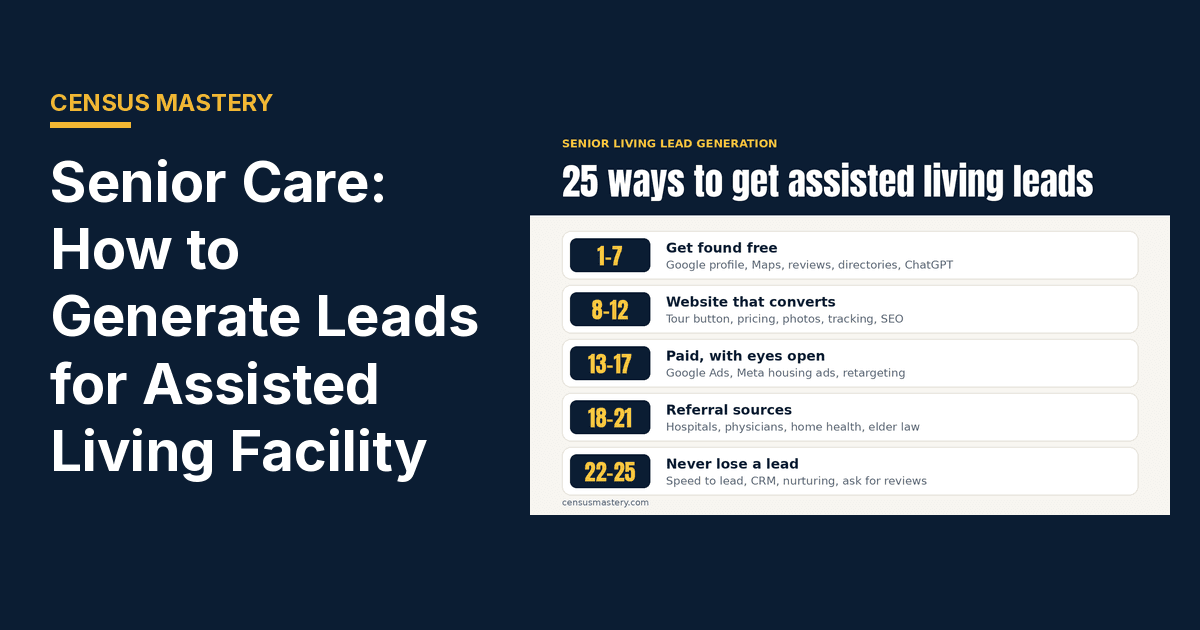
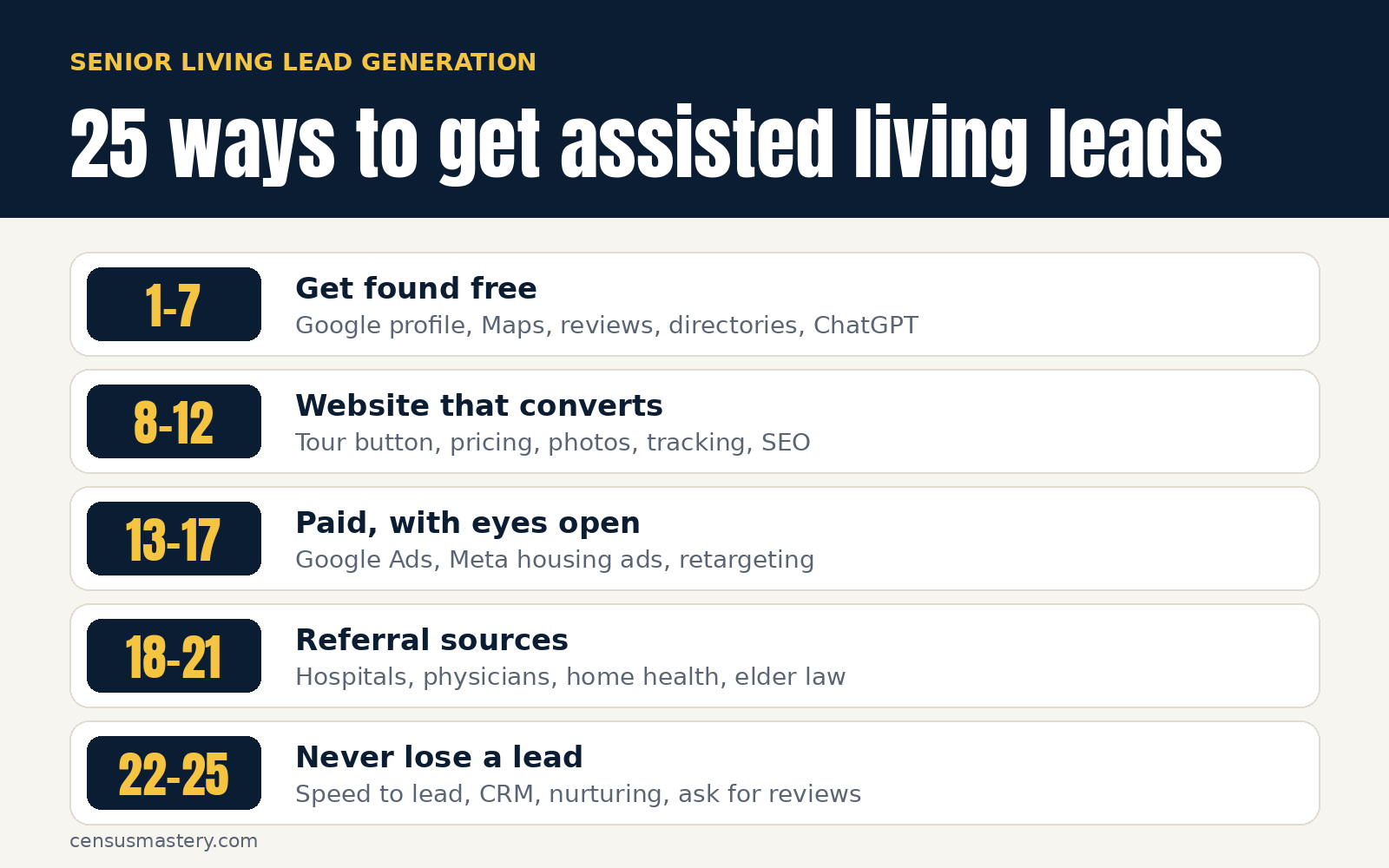
Most of what you will find online is a 2025 guide written for big operators with a marketing team. Here is the honest answer for owners. Most assisted living leads come from a handful of places: Google, referral sources, senior care directories and referral agencies, and word of mouth. The communities that win are not doing 50 things. They do about ten things well and never let a lead go cold. This guide gives you 25 ways to get there, in the order I would do them. These are proven strategies and marketing tips from real experience in senior living, not theory, and they work for a residential assisted living home with eight beds or a larger care facility. They also work for communities that offer independent living and assisted living together.
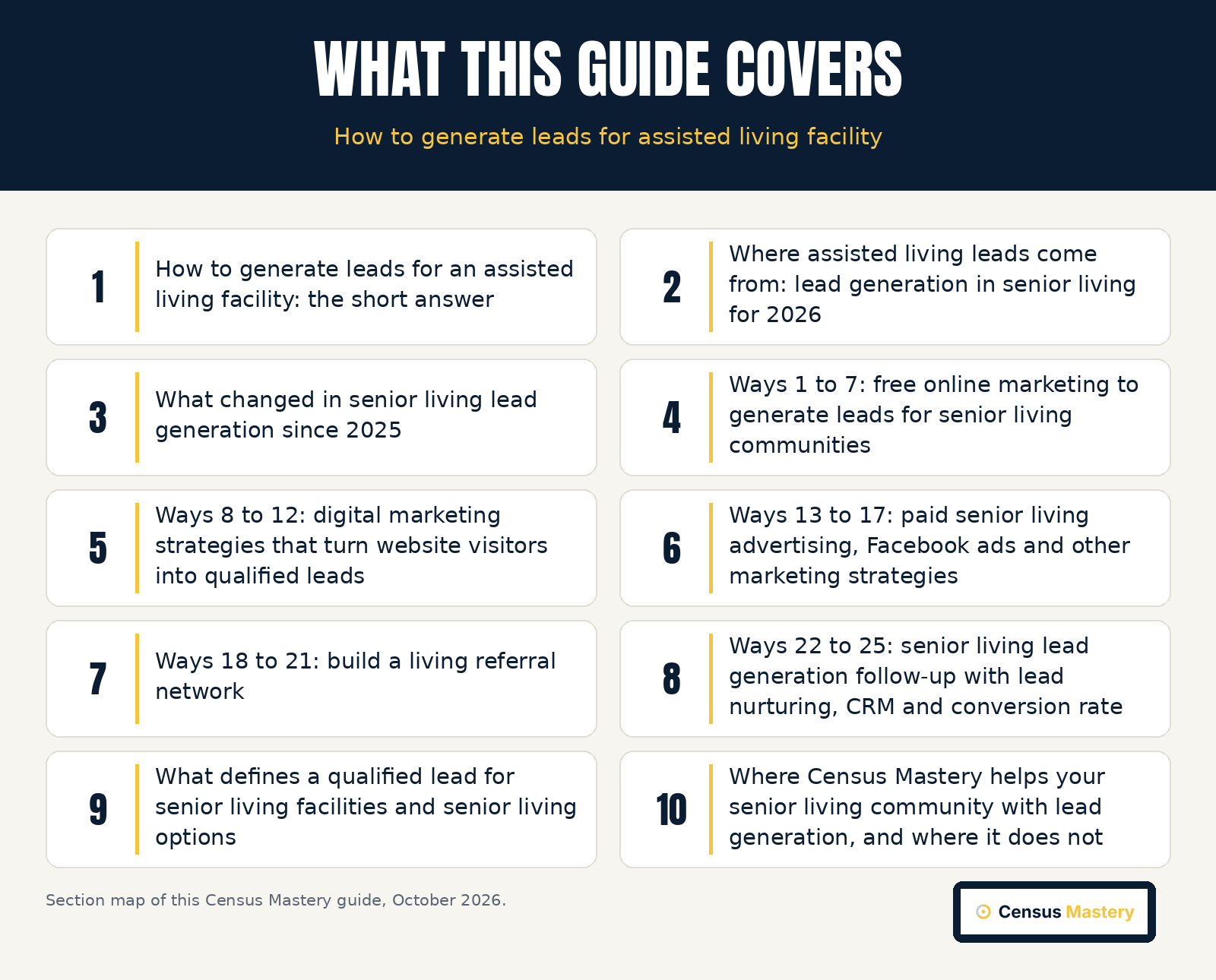
How to generate leads for an assisted living facility: the short answer
To generate leads for an assisted living facility, get found free first: a complete Google Business Profile, steady Google reviews, claimed senior care directories and a website that books tours. Then add referral sources and paid ads, and answer every inquiry within minutes. Qualified leads come from trust, not volume.
The quick list:
- Complete your Google Business Profile
- Rank on Google Maps across your whole area
- Ask every family for a Google review
- Reply to every review, safely
- Claim your senior care directories
- Show up when families ask ChatGPT
- Host events people actually come to
- Put a tour button and phone number everywhere
- Publish a starting price
- Show real life at your community
- Track every call and form by source
- Answer family questions with content
- Run Google Ads on high-intent searches
- Run Facebook ads the right way
- Retarget your website visitors
- Use referral agencies on your terms
- Watch who else is advertising
- Win hospital discharge planners
- Work with physicians and home health
- Build a professional referral network
- Ask your families and staff for referrals
- Answer every lead within minutes
- Put every lead in one CRM
- Nurture leads who are not ready yet
- Measure lead quality, not just lead count
Where assisted living leads come from: lead generation in senior living for 2026
Senior living leads come from families searching online, professional referral sources, referral agencies like A Place for Mom, and word of mouth. A Google search sits in the middle of almost all of them, because even a referred family checks your reviews before they call. Knowing your own mix tells you where to spend.
One older industry figure is worth knowing. A 2018 NIC MAP blog post by VisionLTC said research suggests about 70 percent of assisted living leads come from professional referral sources, from physicians to home health agencies. Treat that as an older estimate, not today's rule. In my experience, the online share has grown a lot since then, because adult children researching care options do it on their phones.
What has not changed is how families decide. Seniors and their families make decisions about senior living slowly and carefully, and most senior living decisions start with a search, a review site or a question to a friend. Your target audience is usually the adult child, not the senior. The BrightLocal Local Consumer Review Survey 2026 found 97 percent of consumers read reviews before choosing a local business, and 45 percent now use AI tools like ChatGPT for local recommendations, up from 6 percent a year earlier. If you want the full breakdown, read where assisted living leads come from.
What changed in senior living lead generation since 2025
The biggest change since 2025 is AI search. BrightLocal found 45 percent of consumers now use AI tools like ChatGPT for local recommendations, up from 6 percent a year earlier. Families still read Google reviews, but now an AI answer often picks the short list before anyone visits your website or calls.
That does not replace the basics. AI tools pull from the same places families do: your reviews, your directory listings and your website. So the free work in ways 1 to 12 now pays off twice. Check what ChatGPT, Gemini and Google AI Overviews say when someone asks for assisted living in your town, and fix the gaps.
Ways 1 to 7: free online marketing to generate leads for senior living communities
The cheapest senior living leads are the ones Google, directories and AI tools send you for free. Families searching for assisted living near them see your Google profile, your reviews and your listings first. Fix those and you turn local search into calls without paying for a single click.
1. Complete your Google Business Profile
Your Google Business Profile is the most valuable free listing you have. Pick the right primary category, list every care level you offer, add your hours, answer the questions people ask, post weekly and upload real photos. A profile with two-year-old posts and 14 photos looks like nobody is home.
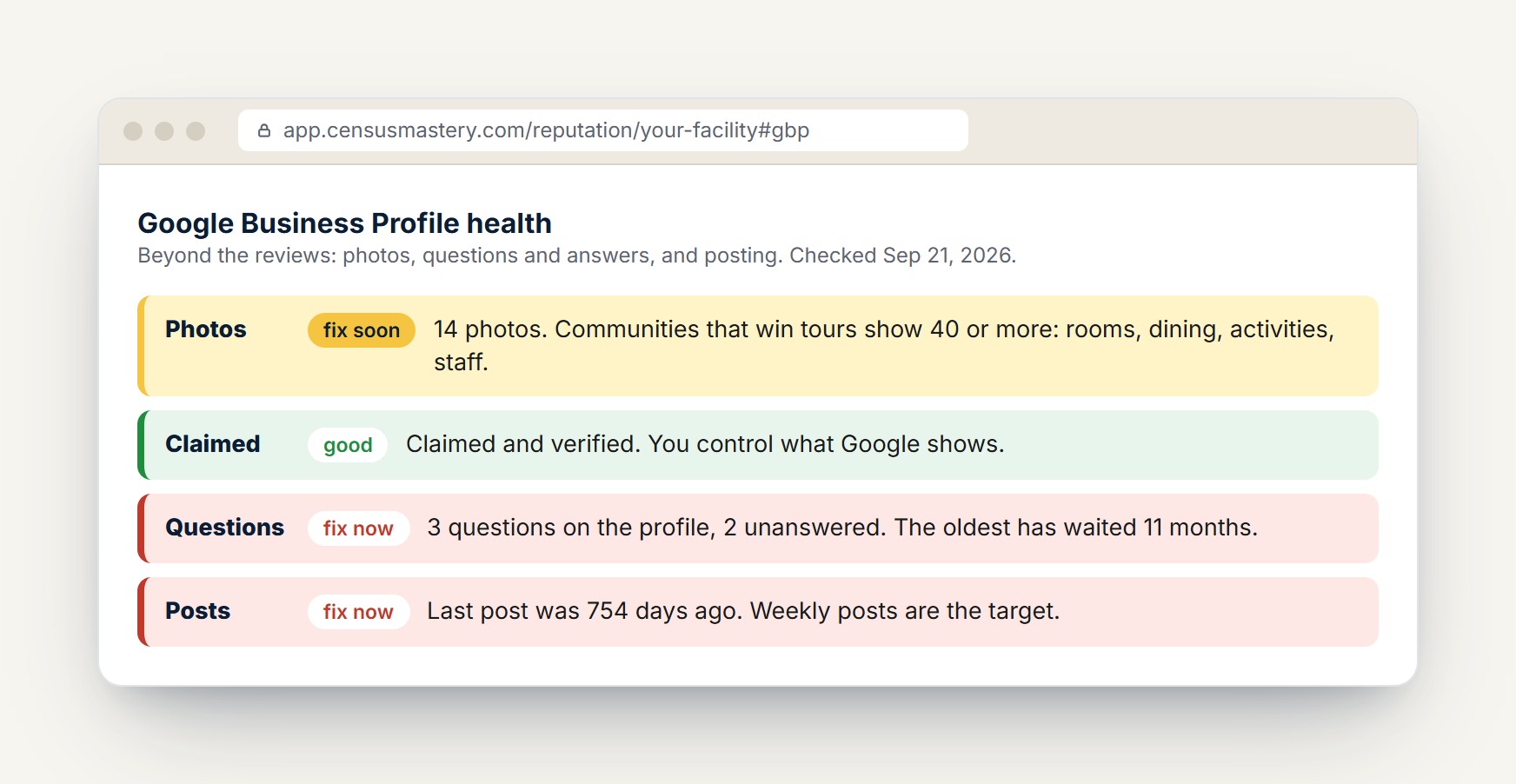
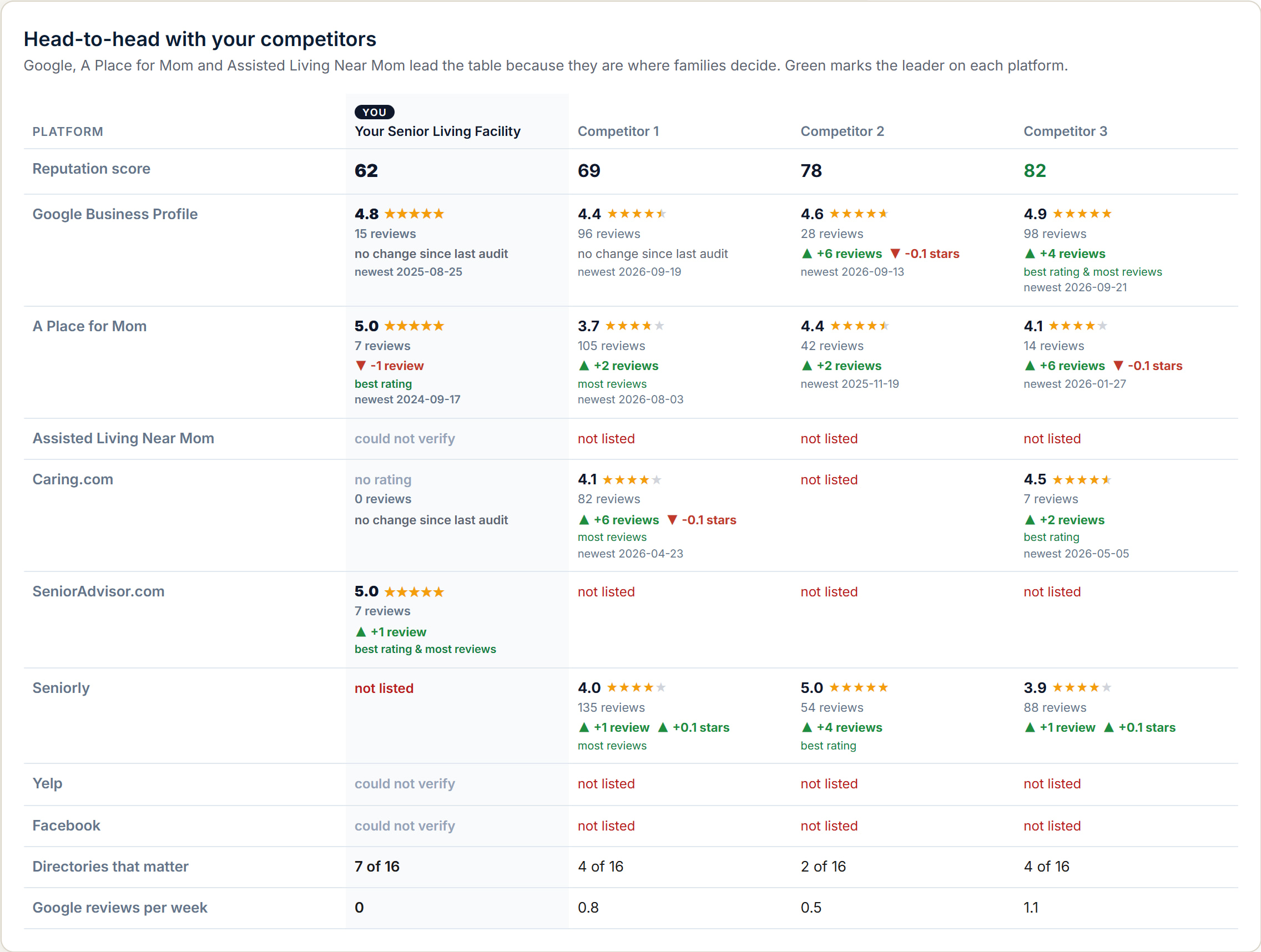
Our Google Business Profile and map rank feature checks this every two weeks and tells you what to fix in plain sentences.
2. Rank on Google Maps across your whole area
You might be number one on Google Maps from your own parking lot and number 15 near the hospital. Check your rank across a grid of your town for "assisted living," "memory care" and "senior living," then work on the areas where you are weak. Our guide on how to rank higher on Google Maps for assisted living has 19 steps.
3. Ask every family for a Google review
Reviews on Google are the number one trust signal for families researching care, and the best senior living communities in most towns have the most recent ones. Ask every family, not just the ones you think are happy, because asking only happy families is review gating and Google does not allow it. Send a short text with your review link 30 days after move-in. Our guide to getting more Google reviews for assisted living has scripts.
4. Reply to every review, safely
Replies show families that someone is paying attention. Keep them short and kind, and never confirm that the reviewer is a resident or family member, because that can be a HIPAA problem. "Thank you for sharing this" is safe. "We love having your dad here" is not. See HIPAA compliant review responses.
5. Claim your senior care directories
Families use about six review sites when choosing a local business, per BrightLocal. Claim your free listings on Caring.com, Seniorly, SeniorAdvisor, U.S. News and the rest, match your name, address and phone to Google exactly, and add photos. Start with our list of senior living directories.
6. Show up when families ask ChatGPT
A daughter asks ChatGPT for the best assisted living near her mom. Three names come back. Are you one? AI tools lean on your reviews, your directory listings and your website, so the same work above helps here too.
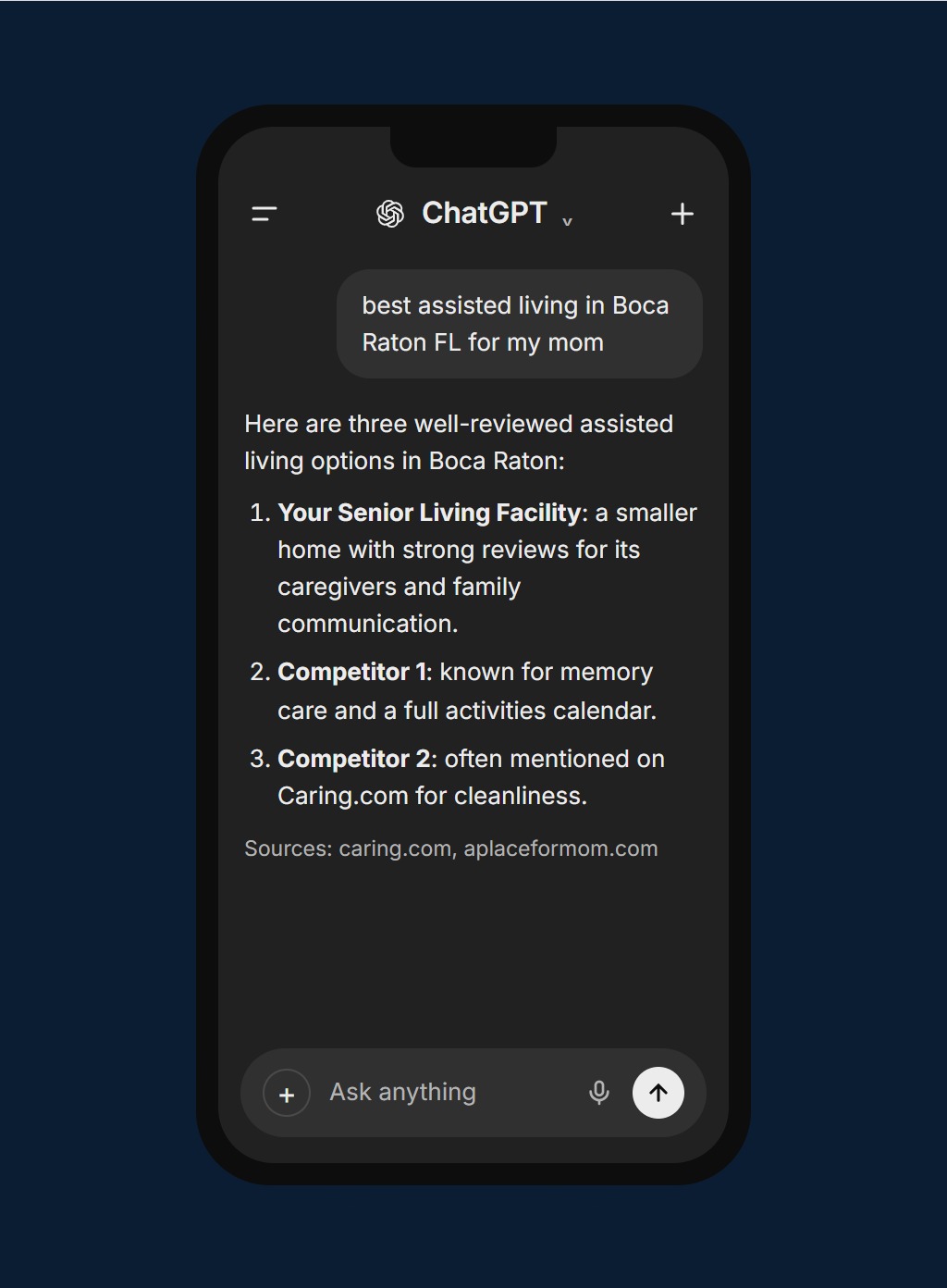
Read how to show up in ChatGPT as an assisted living community, and see what our AI search visibility tracking covers.
7. Host events people actually come to
A caregiver support group, a memory care education night with a local Alzheimer’s organization, a Medicare and benefits talk, a free lunch for local seniors. Events help you connect and engage with families before they need you, and that is the best time to meet them. Collect contact details with permission and follow up. More ideas are in our list of senior living marketing event ideas.
Ways 8 to 12: digital marketing strategies that turn website visitors into qualified leads
Your website should turn families researching care into calls and tour requests. Make the phone number and tour button impossible to miss, answer the cost question, show real life at your community, and track where every call and form comes from. A better conversion rate is often cheaper than more traffic.
8. Put a tour button and phone number everywhere
Phone number in the header, a "book a tour" button above the fold on every page, and a short inquiry form. On a phone, the number should be a tap to call. That is conversion rate optimization in its simplest form. Families researching at 10 PM should be able to ask for a tour in under a minute. See our guide to an assisted living inquiry form.
9. Publish a starting price
"Call for pricing" sends a lot of families to the next website. You do not need to publish every level of care, but a starting price and a plain explanation of what changes the cost builds trust and filters out families who cannot afford you. That improves lead quality, not just lead count. For context, the CareScout 2025 Cost of Care Survey put the national median for assisted living at $6,200 a month, so families arrive expecting a real number.
10. Show real life at your community
Stock photos of smiling seniors do not sell. Real photos of your rooms, your dining room, your activities and your team do. Short resident stories and videos work even better, as long as you have written permission from the resident or their family. Families want to picture their mom living there. This kind of care marketing for senior living is how you connect with potential residents early, and it keeps you in front of potential residents and their families long before they are ready to tour.
11. Track every call and form by source
If you do not know which channel sends your move-ins, you will keep paying for the wrong ones. Basic analytics matter here. Track phone taps, form fills and their source, from Google search and Google Maps to Facebook, ChatGPT and directories. Our website tracking does this on every plan, and our guide to call tracking for assisted living explains the options.
12. Answer family questions with content
Families type real questions: how much does assisted living cost, when is it time, assisted living vs memory care, does Medicare pay. Answer those on your website in plain language, or on a short video or podcast episode with your director. Effective digital marketing is mostly this: good content marketing and basic search engine optimization bring families who are already looking, and help AI tools understand what you offer.
Ways 13 to 17: paid senior living advertising, Facebook ads and other marketing strategies
Paid ads can bring leads fast, but they cost real money and the rules are tricky. Google Ads catch families searching right now. Facebook ads build awareness under Meta's housing rules. Referral agencies charge per move-in. Pick one channel, track cost per lead and cost per move-in, and cut what does not work.
13. Run Google Ads on high-intent searches
Bid on searches like "assisted living near me," "memory care [your town]" and your own name, not broad terms like "senior care." Send clicks to a page with a tour button, not your home page. Clicks in senior living can be expensive, so start small and watch cost per tour, not just cost per click. Our guide to Google Ads for assisted living covers setup. If you hire help, know the going rates. One agency, SeniorLivingLeads.com, lists $499 a month for management with suggested ad spend starting at $2,000, and says it works with senior living companies that have more than 5 communities (checked October 19, 2026). Smaller owners often run a tight campaign themselves first.
14. Run Facebook ads the right way
Meta Platforms, the company behind Facebook and Instagram, has special ad categories for housing ads, with limited audience tools to prevent discrimination, and most senior living marketers run community ads under the housing category. That means you cannot simply target women aged 50 to 65 near you. Let the creative do the targeting: speak to the adult child worried about mom living alone. See assisted living Facebook ads.
15. Retarget your website visitors
Most families visit your website several times before they call. Retargeting shows your ads to people who already visited. Keep it general and never base it on a care need a family typed into a form. Show a tour invite, a resident story or an event, not a diagnosis.
16. Use referral agencies on your terms
A Place for Mom is free to families. Per its own site, it is paid by participating communities when a family it referred moves in. Agencies can fill a bed, but they cost real money per move-in and you share the lead with competitors. Use them beside your own marketing, not instead of it. See assisted living referral agencies and senior living referral fees. Compare A Place for Mom alternatives if you want move-ins without the fee, and see how much A Place for Mom charges before you renew.
17. Watch who else is advertising
Before you spend, look at who in your market is already paying for Google and Facebook ads, and how many. If most communities near you are running Google Ads, every free click from a strong Google profile is worth more to you.
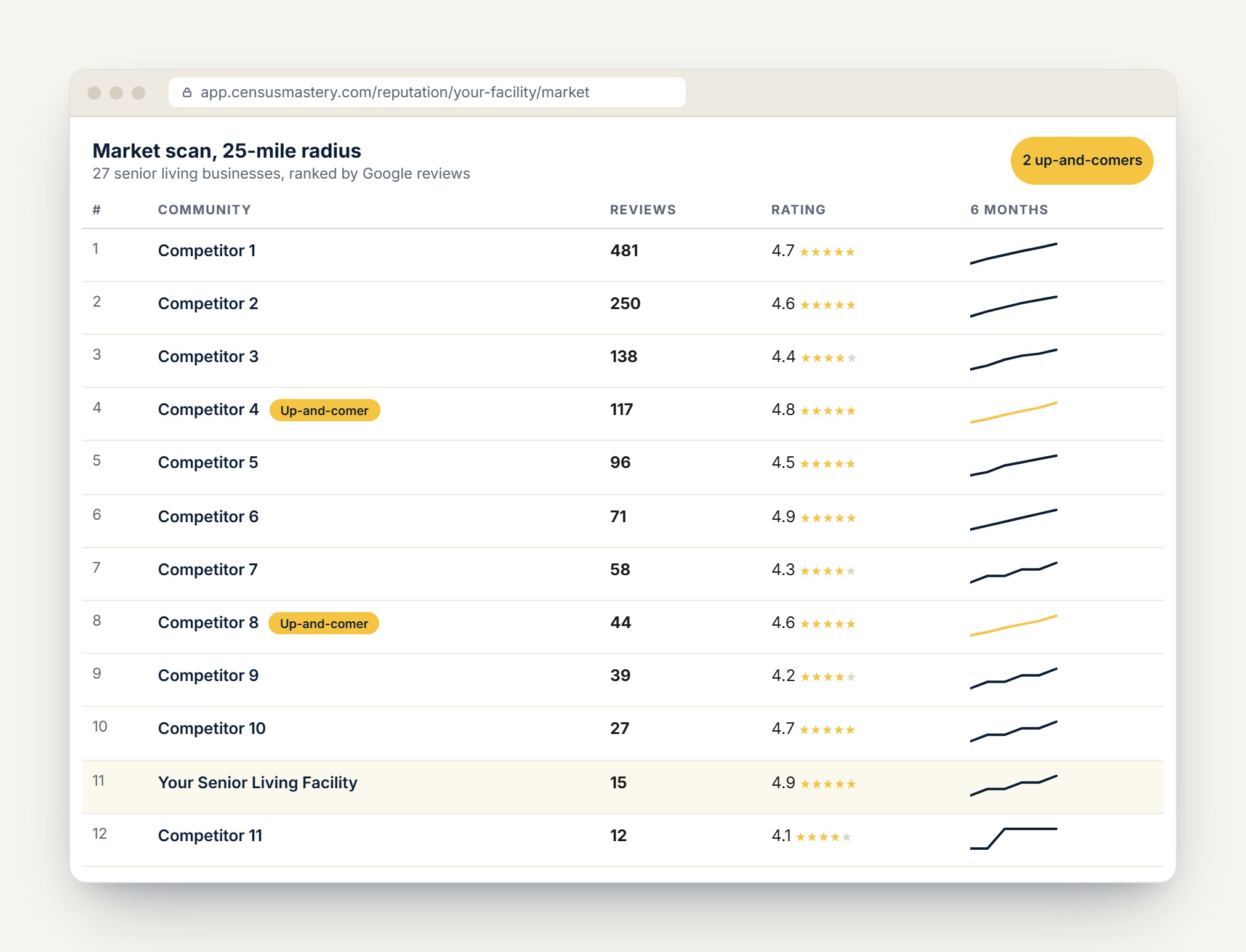
Our paid ads in your market view reads Google's and Meta's public ad records so you can see who is advertising, without guessing what anyone spends.
Ways 18 to 21: build a living referral network
Professional referral sources like hospitals, physicians, home health agencies and elder law attorneys can send steady, qualified leads at a low cost per lead. They refer to communities they trust and find easy to work with. Treat each one like a customer, and track every visit and every referral.
18. Win hospital discharge planners
Discharge planners and case managers need a fast answer: can you take this patient, at what care level, and how soon? Give them one name and one cell number. Respond in an hour, not a day. Follow up on every referral, even the ones that went somewhere else. Our guide to discharge planner referrals goes deeper.
19. Work with physicians and home health
Geriatric physicians, neurologists and home health agencies see families right when care needs change. The NIC MAP piece above makes a good point: sell to what the referral source cares about. For physicians that may be fewer hospital readmissions and good communication. For home health, it is a smooth handoff when home is no longer safe.
20. Build a professional referral network
Elder law attorneys, financial planners, geriatric care managers, churches, senior centers and hospice teams all hear "we need help with mom." Make a list, visit a few each month, bring something useful, and log every visit. See our full list of senior living referral sources and how to get referrals for assisted living.
21. Ask your families and staff for referrals
Your best marketers already live and work in your building. Happy residents and families tell friends at church. Staff know neighbors with aging parents. Ask them directly, make it easy to pass along your number, and thank them every time. Check your state's rules before offering any referral reward.
Ways 22 to 25: senior living lead generation follow-up with lead nurturing, CRM and conversion rate
Generating leads is only half the job. The other half is turning them into tours and move-ins. Answer every inquiry fast, keep every lead in the best senior living CRM, nurture families who are not ready yet, and measure lead quality and conversion rate so you know which marketing strategies actually fill beds.
22. Answer every lead within minutes
A family in a hurry calls three communities. The first one to answer usually gets the tour. Set a simple rule: every inquiry gets a live response within minutes during business hours and first thing the next morning after hours. Read speed to lead in senior living.
23. Put every lead in one CRM
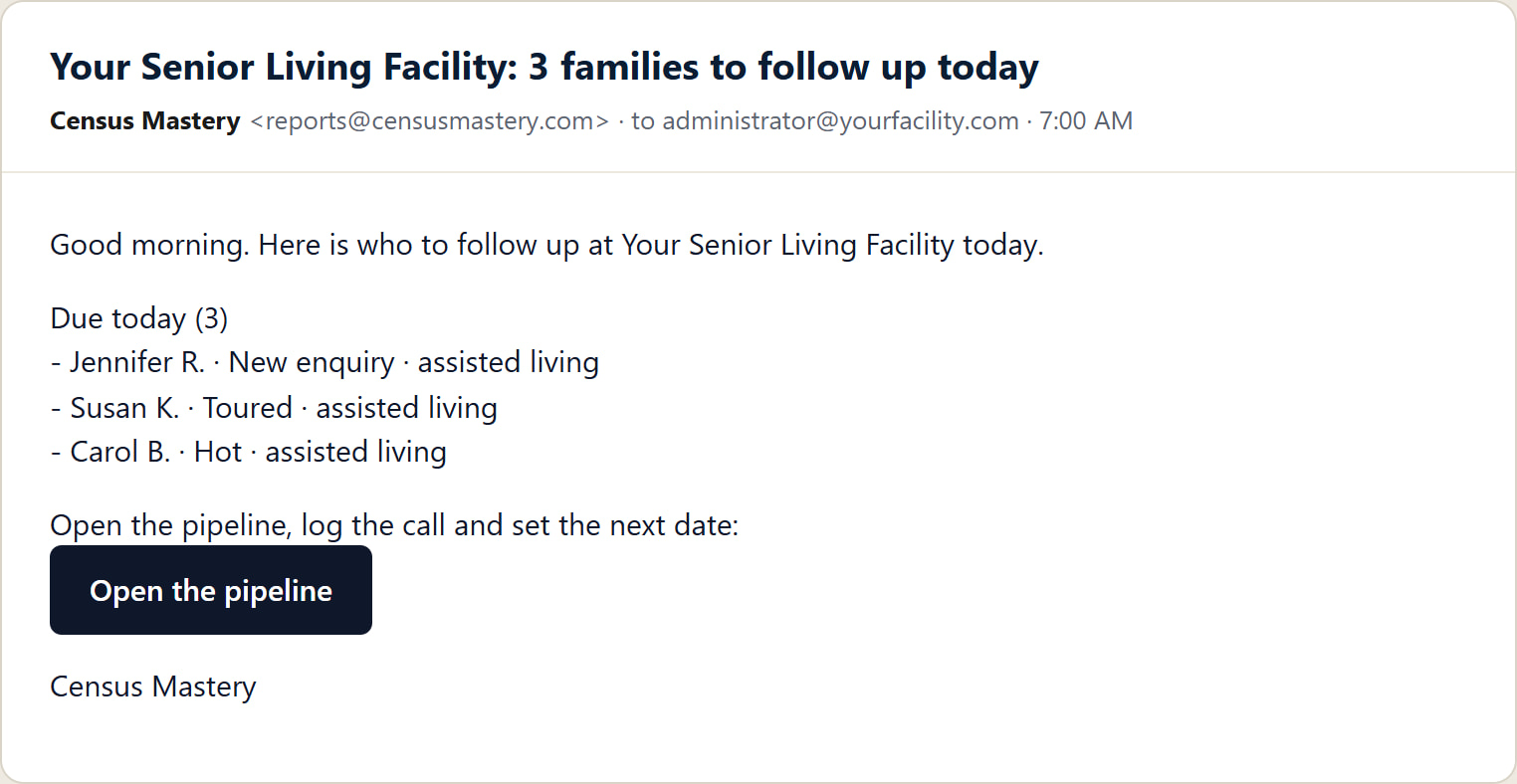
Sticky notes lose families. Every inquiry from every source goes into one pipeline with a stage, a next step and a date. Small communities do not need a big system, but they do need one place. Our senior living CRM is on every plan, with a morning email of who to call today. Read our senior living CRM guide and the assisted living CRM software buyer's guide. Our census management software guide shows how those numbers tie to occupancy. Unsure if you need one? Read do small assisted living facilities need a CRM.
24. Nurture leads who are not ready yet
Many families start researching months before a move. Put them on a gentle plan: a monthly email with something useful, an event invite, a check-in call every few weeks. Lead nurturing is how a cold lead in March becomes a move-in in July. Never let a lead sit with no next step. Leads are only half of census, so pair this with our guide on how to increase census in assisted living.
25. Measure lead quality, not just lead count
Leads generated is a vanity number on its own. Track inquiries by source, inquiry-to-tour rate, tour-to-move-in rate and cost per move-in. One channel might send 40 leads and no move-ins. Another might send five leads and three move-ins. Good data beats gut feel, and lead management gets easier when the information lives in one place. Lead scoring can be simple: timeline, care level, budget and who is deciding. See senior living cost per lead and assisted living lead tracking.
What defines a qualified lead for senior living facilities and senior living options
A qualified lead is a family with a real care need, a timeline within the next few months, a budget or payer that fits your community, and a decision maker you are talking to. Matching them with the appropriate care level early saves everyone time and improves your tour-to-move-in conversion rate.
Understanding their needs comes first. Ask four questions on the first call: who is the care for, what help do they need day to day, when do you need a move, and how are you planning to pay. Those answers tell you how likely the family is to convert (a family likely to convert usually has a timeline and a payer), and which types of senior care fit them: assisted living, memory care or independent living, or if another care option fits better. Even when a lead is not a fit, send them somewhere helpful. Families remember that, and so do the people they tell.
Where Census Mastery helps your senior living community with lead generation, and where it does not
Census Mastery covers the free online side of senior living lead generation: your Google profile and Maps rank, reviews, directories, AI search visibility, website call and form tracking, and a lead pipeline with a daily follow-up email. It does not run your ads, call your leads or visit referral sources for you.
It is built only for senior living, from $79 a month, with a 30-day money-back guarantee. The Full Census and Waitlist plans add a move-in guarantee: at least one move-in, or you get Census Mastery free for life plus 6 months of marketing worth US$12,000. Terms apply.
The gaps, plainly: there is no phone system, no webchat on your website, no call center and no human team answering leads for you. If you need someone to pick up the phone at night, you will want an answering service or call center beside it.
To see where you stand against the communities near you, start with your free Census Score. It takes about 20 minutes, and the report is yours either way.
Frequently asked questions about assisted living lead generation
These are the questions assisted living owners ask most about lead generation in senior living: cost, timing, social media, paid ads and buying leads. Short answers below, with links to deeper guides. If you only take one thing away, make it this: speed and follow-up beat volume.

What are the best lead generation strategies for senior living communities? A complete Google Business Profile, steady reviews from every family, claimed directories, a website that books tours, and two or three strong referral sources. Then fast follow-up in a CRM: see Census Mastery vs WelcomeHome. Paid ads come after those basics.
How can senior living communities use social media for lead generation? Post real life at your community, events and team stories on Facebook and Instagram. Use Facebook ads under Meta's housing rules for awareness and retargeting. Social media builds trust; the call usually comes later through Google or your website.
What is the typical lead-to-move-in timeline for senior living? It varies widely. A hospital discharge can move in days. A planned move can take months. Track your own average in your pipeline so you know how long to keep nurturing.
Should you buy assisted living leads? Purchased leads can be shared with several communities at once, so quality varies. Test small and track move-ins, not lead count. Read should you buy assisted living leads.
How important are online reviews for senior living communities? Very. BrightLocal's 2026 survey found 47 percent of consumers will not consider a business with fewer than 20 reviews, and 31 percent will not consider one under 4.5 stars.
What digital marketing techniques help you get more leads and increase occupancy rates? A complete Google profile, fresh reviews, a fast website with a tour button, and simple tracking. Those digital marketing basics are how you market assisted living without a big budget, and they make every other channel work better.
How does SEO help senior living communities generate leads? Families search for care in your town and for answers to their questions. Ranking for both brings families who are already looking, without paying per click. Your Google Business Profile is the biggest local SEO for senior living lever.
What is a senior living call center? A service that answers your inquiry calls, often after hours, and books tours or passes leads to your team. It helps if calls go to voicemail at night. Make sure the leads land in your CRM the same day.
What metrics should senior living communities track for lead generation? Inquiries by source, speed to first response, inquiry-to-tour rate, tour-to-move-in rate, cost per lead and cost per move-in. Review them monthly and move budget to what fills beds.
How to market senior living with a small budget? Start with the free ways in this list, 1 to 12, and 18 to 25. They cost time, not money. Our guide on how to market a small assisted living facility has more. The full plan is in how to market an assisted living facility.