Local SEO for Senior Living: Search Engine Optimization and Senior Living SEO Strategies to Reach Prospective Residents, With or Without an SEO Agency
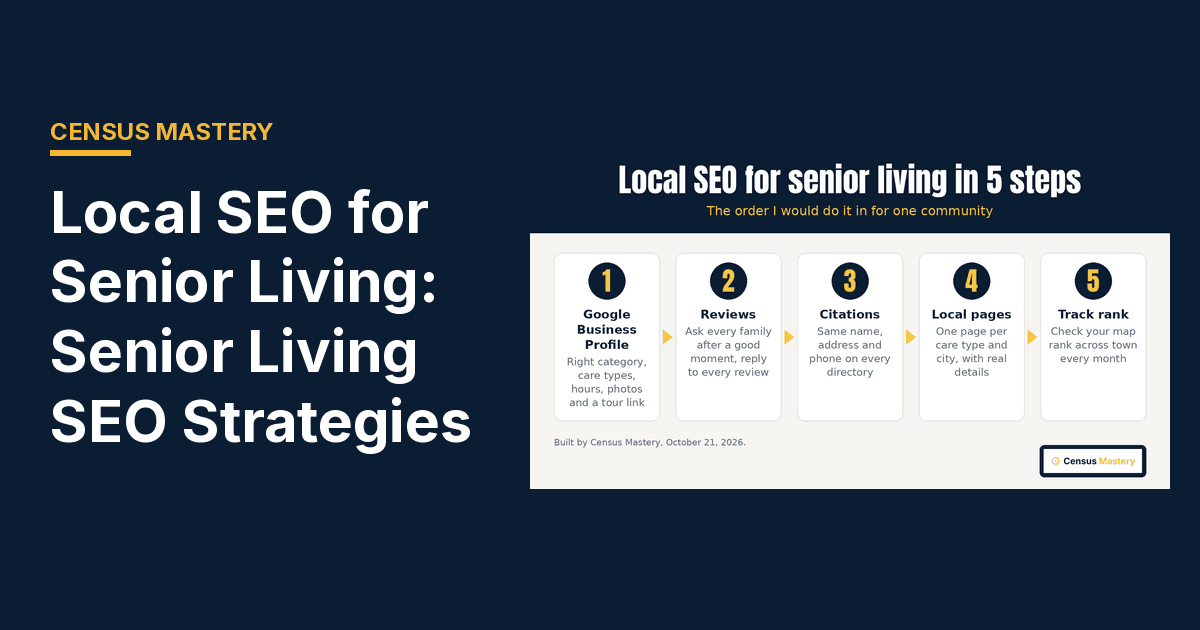
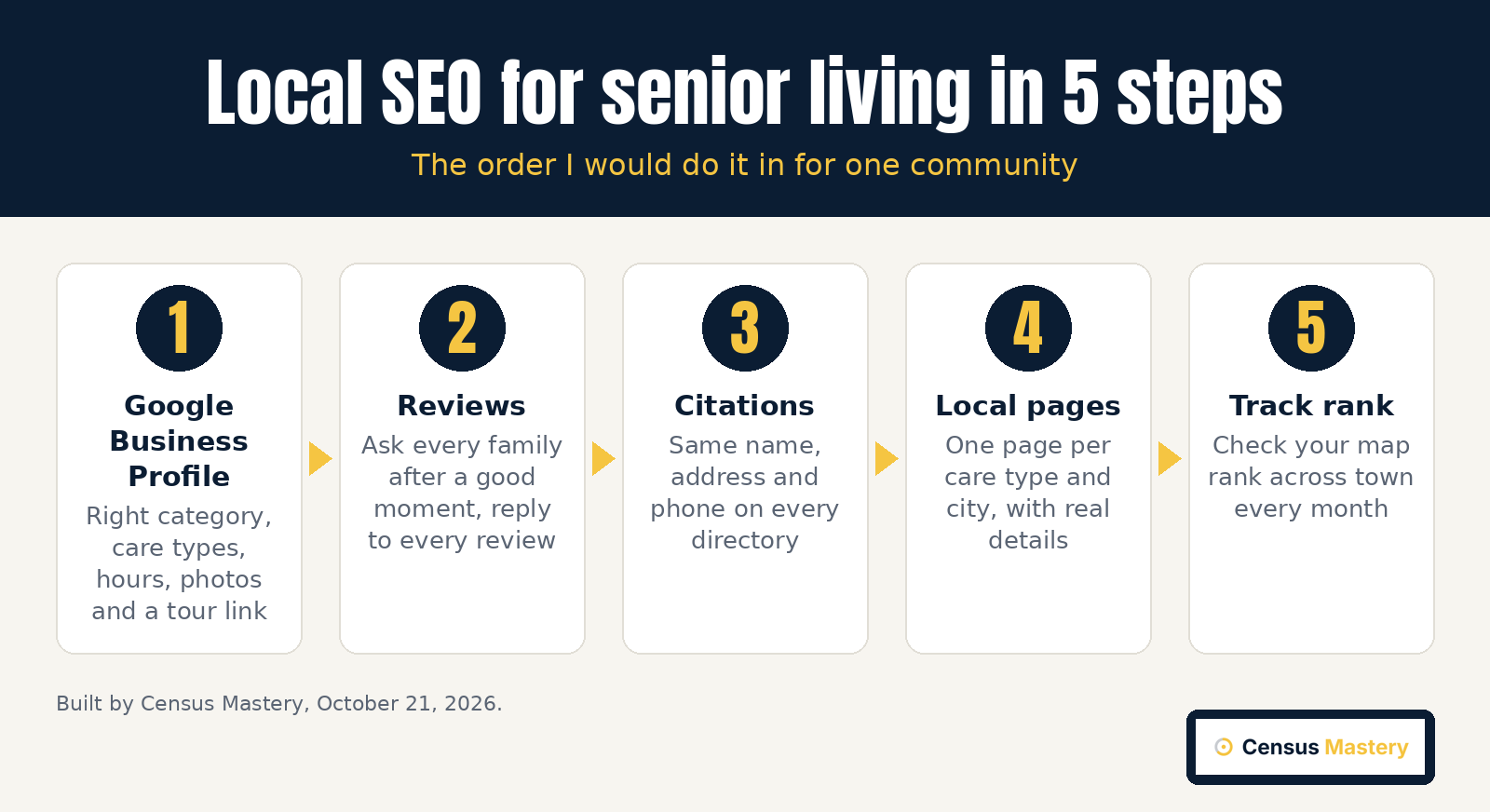
Local SEO for senior living means showing up when families search for care near them, on Google Maps, in local search results and now in AI answers. For most assisted living communities, five things move rankings: a complete Google Business Profile, steady reviews, consistent listings, a page for each care type and city, and monthly rank tracking.
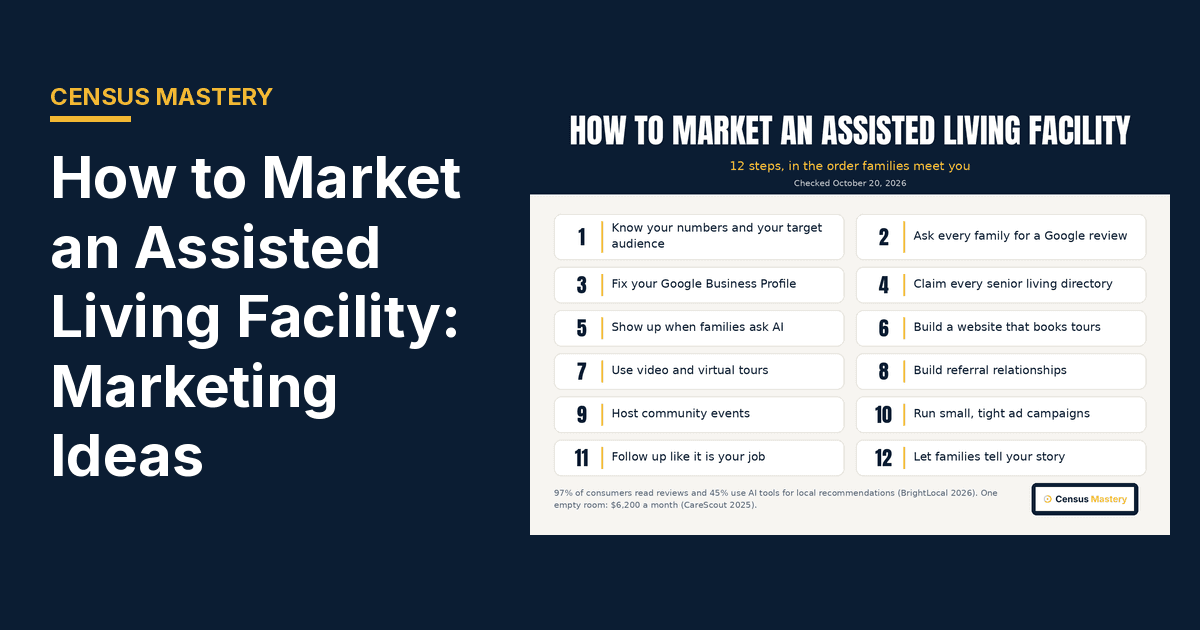
I'm Ronald Osborne, founder of Census Mastery. I built Census Mastery for senior living owners, and local search is where I see communities leave the most move-ins on the table. This guide lays out the living SEO strategies I would run for one community, in order, and they work for assisted living facilities, memory care and other senior care providers. Good SEO strategies are a marketing strategy, not a side project. It is part of our bigger guide on how to market an assisted living facility.
Why senior living SEO matters: search visibility for senior living communities
Potential residents and their families start local, and senior living marketing has to meet them there. Your target audience is usually an adult daughter or son actively searching for senior living for a parent. They type "assisted living near me" or "memory care" plus a city, then compare the three communities in the map pack. If you are not there, you are not on the list.
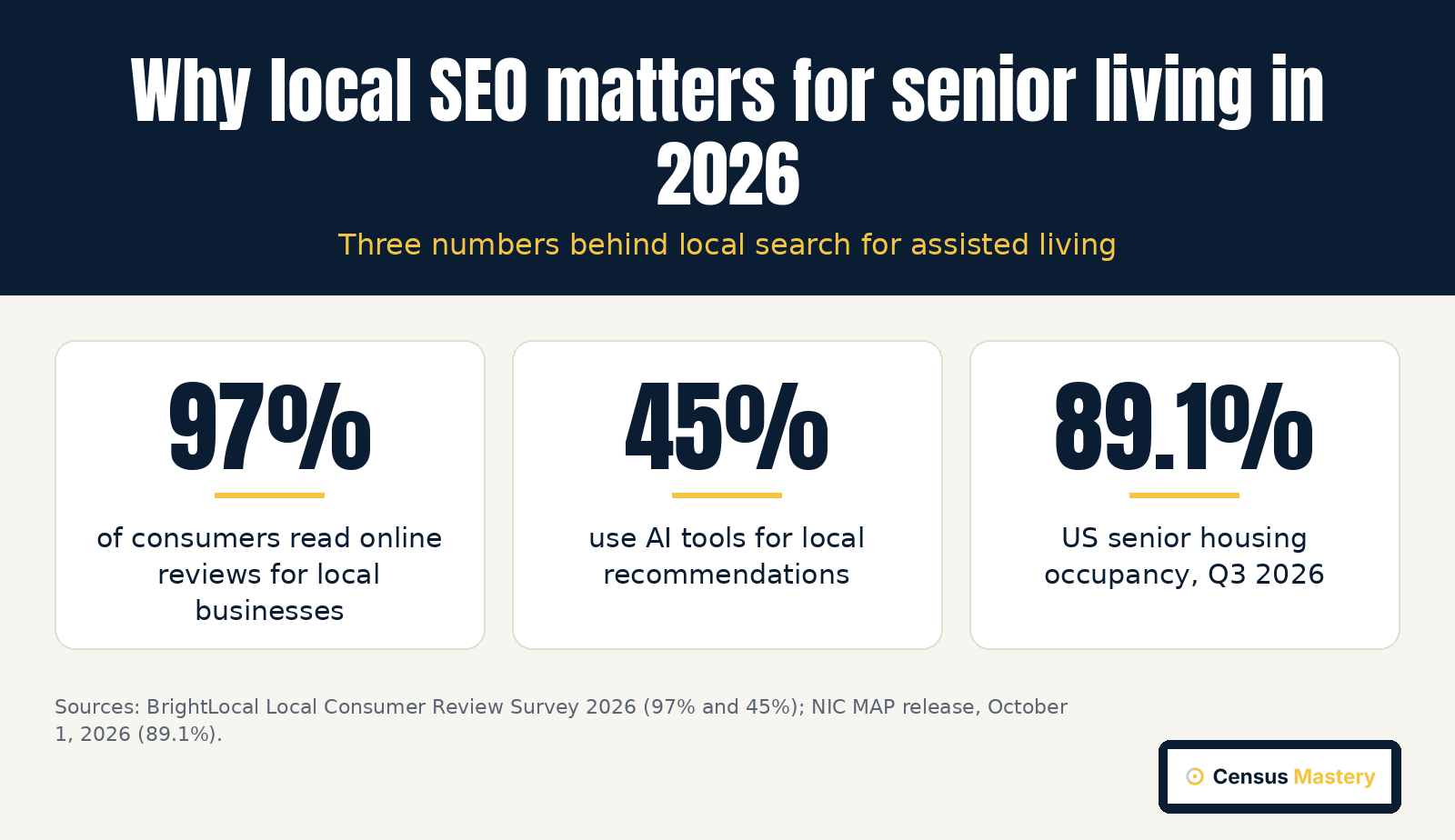
- Reviews drive the choice and your online presence. In the BrightLocal Local Consumer Review Survey 2026, 97 percent of consumers read online reviews for local businesses.
- AI is now a search engine too. The same survey found 45 percent use AI tools for local recommendations.
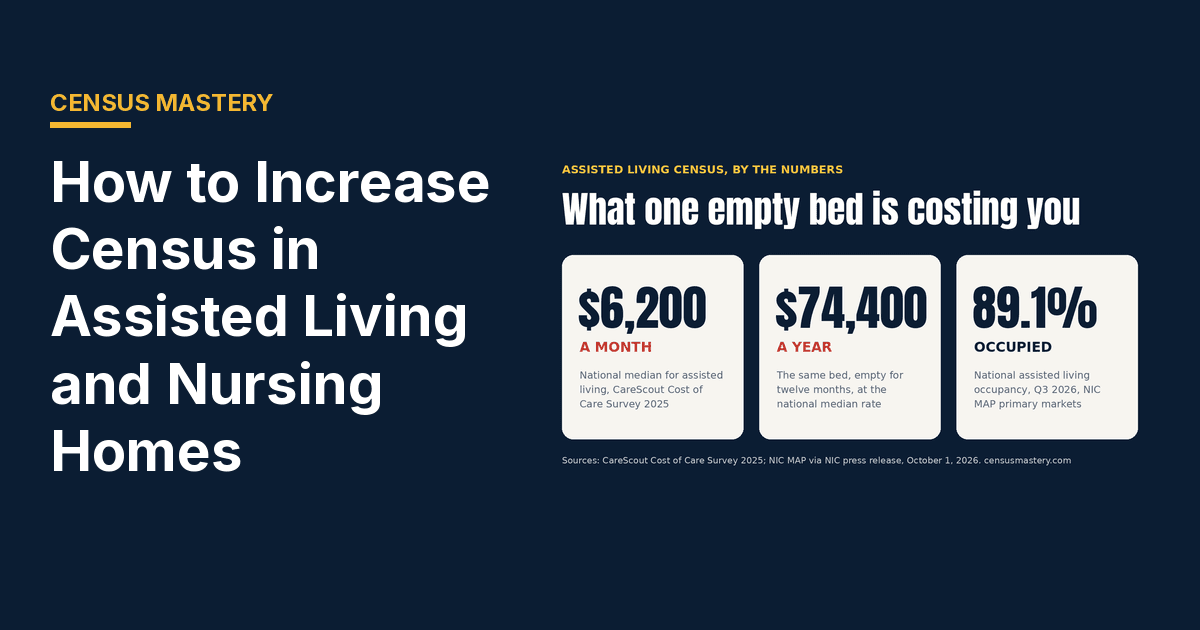
- Competition is tight. US senior housing occupancy reached 89.1 percent in the third quarter of 2026, per the NIC release of October 1, 2026. When most markets are full, the communities with empty rooms need search visibility most.
Every empty room costs real money. The national median for assisted living is $6,200 a month (CareScout Cost of Care Survey 2025), so one extra move-in from local search can pay for a year of SEO work.
How the search engine ranks assisted living communities: higher ranking factors
Google says local results are based mainly on relevance, distance and prominence. It also says there is no way to pay for a better local ranking.
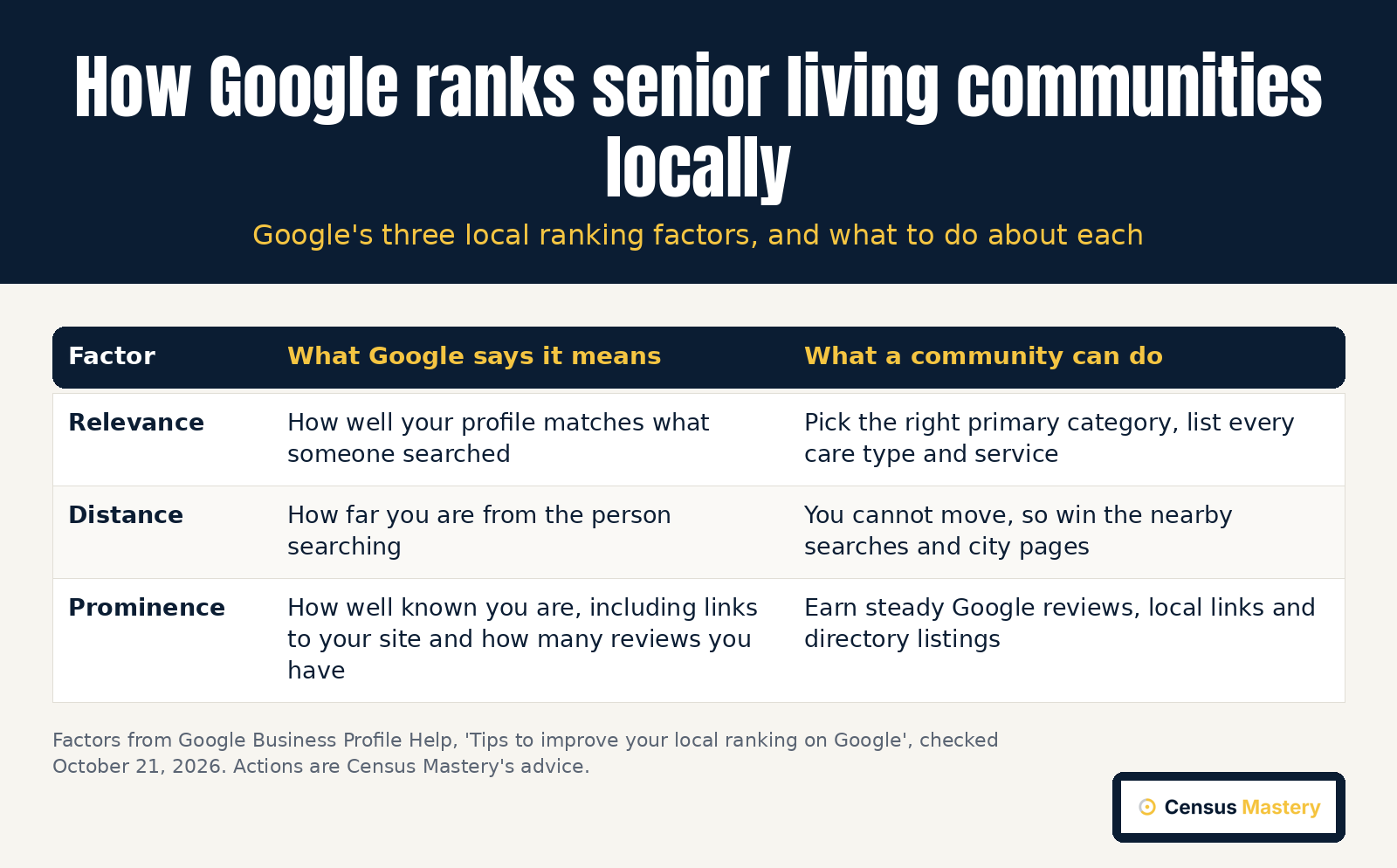
| Factor | What Google says | What your community can do |
|---|---|---|
| Relevance | How well your Business Profile matches the search | Choose the right category and list every care type |
| Distance | How far you are from the person searching | Win nearby searches and build city pages |
| Prominence | How well known you are, including links and reviews | Earn reviews, local links and directory listings |
Source: Google Business Profile Help, "Tips to improve your local ranking on Google," checked October 21, 2026.
Step 1: Optimize your Google Business Profile for local visibility
Your Google Business Profile is the most important asset for search engine optimization you own. Google says businesses with complete and accurate information are more likely to show up in local search results.
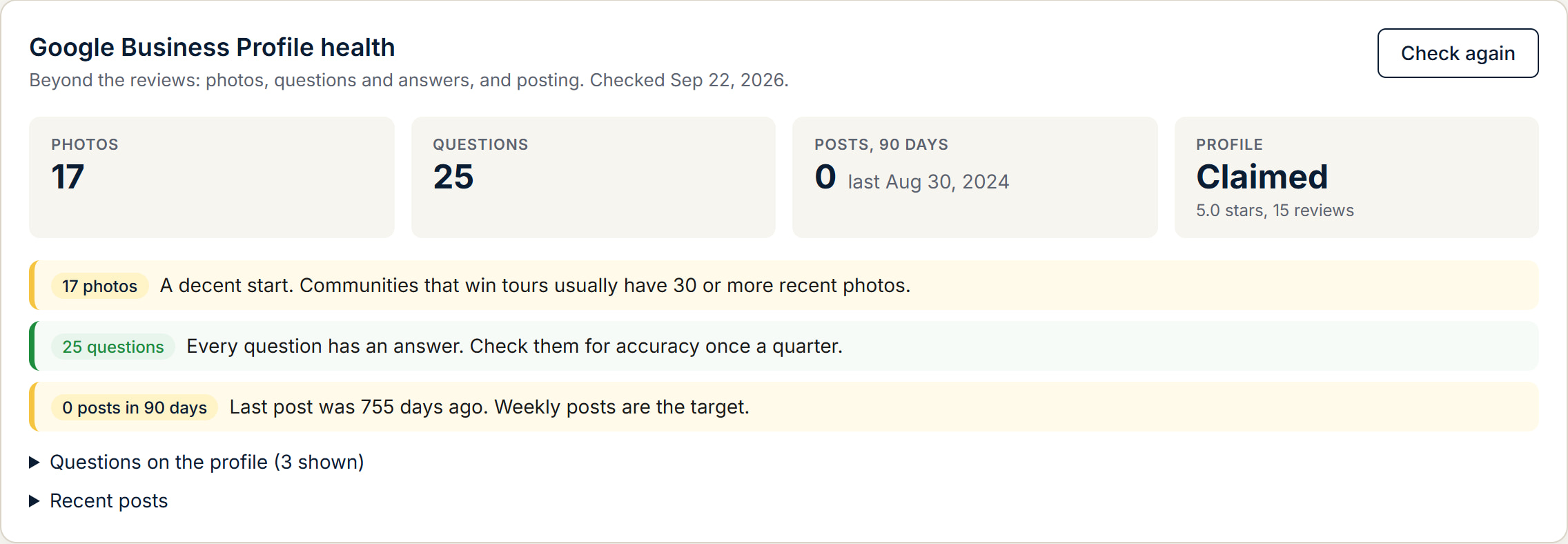
- Verify the profile and claim it in the community's own name, not an agency's.
- Set the primary category to match your main care type, and add secondary categories for memory care or respite.
- Fill in hours, phone, website, attributes and a short description that names your city.
- Add real photos of rooms, dining, activities and staff every month.
- Use posts and the Q&A section to answer what families ask on tours.
Step 2: Reviews that build trust and ranking
Reviews help you rank and help families choose. Google says more reviews and positive ratings can help your local ranking, and that replying to reviews shows you value feedback.
The simple rule: ask every family, at a good moment, by text and email. A family who just had a great care conference or a lovely birthday party in the dining room is the right ask. Then reply to every review within a day or two, without sharing any health details.
Our guide on senior living reputation management covers tools that make this routine, and our senior living reputation management page shows the checks. Our checklist on how to choose senior living reputation management software helps you compare them.
Step 3: Citations, NAP consistency and basic SEO
A citation is any listing of your name, address and phone number (NAP) on another site. Keep them identical everywhere: Google, Apple Business Connect, Bing Places, Yelp, Facebook and the senior living directories families use.
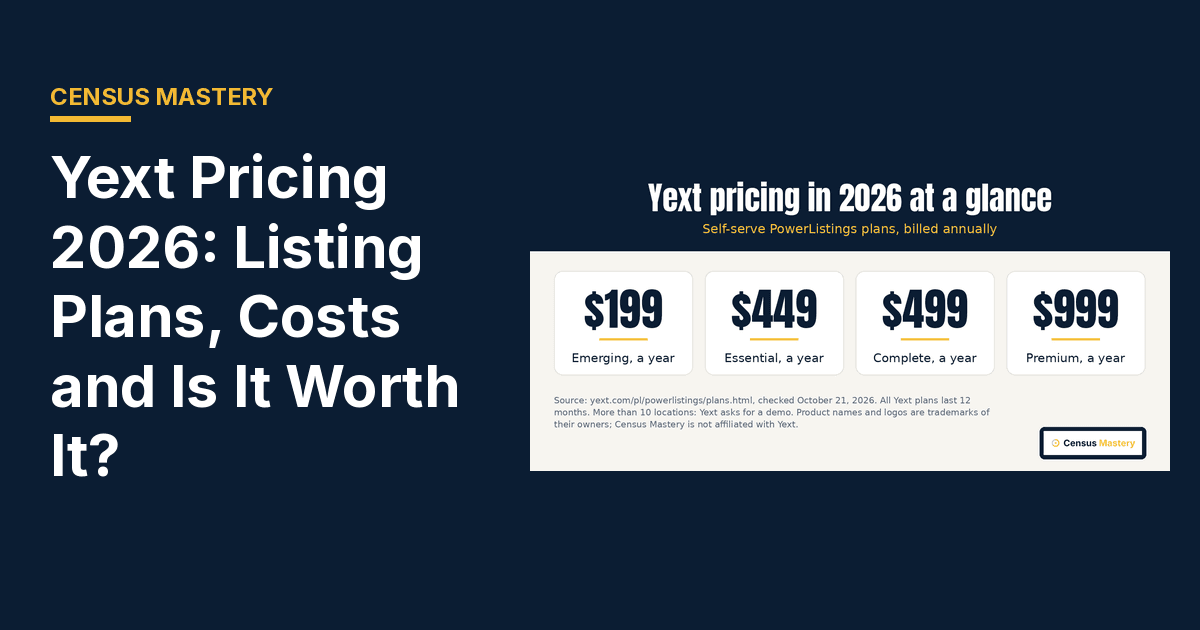
Check the top ten sites by hand first. If many are wrong, a listings tool can help; see our breakdown of Yext pricing and our BrightLocal alternatives guide before you buy one. Directory listings on senior living sites also matter for prominence, and our A Place for Mom alternatives guide covers the main ones.
Step 4: Keyword research, meta titles, technical SEO and content marketing
Keyword research is about matching each of the local searches families make to the right page, so you reach the top of search results for the keyword that matters. Families searching for senior living options use care type plus place.
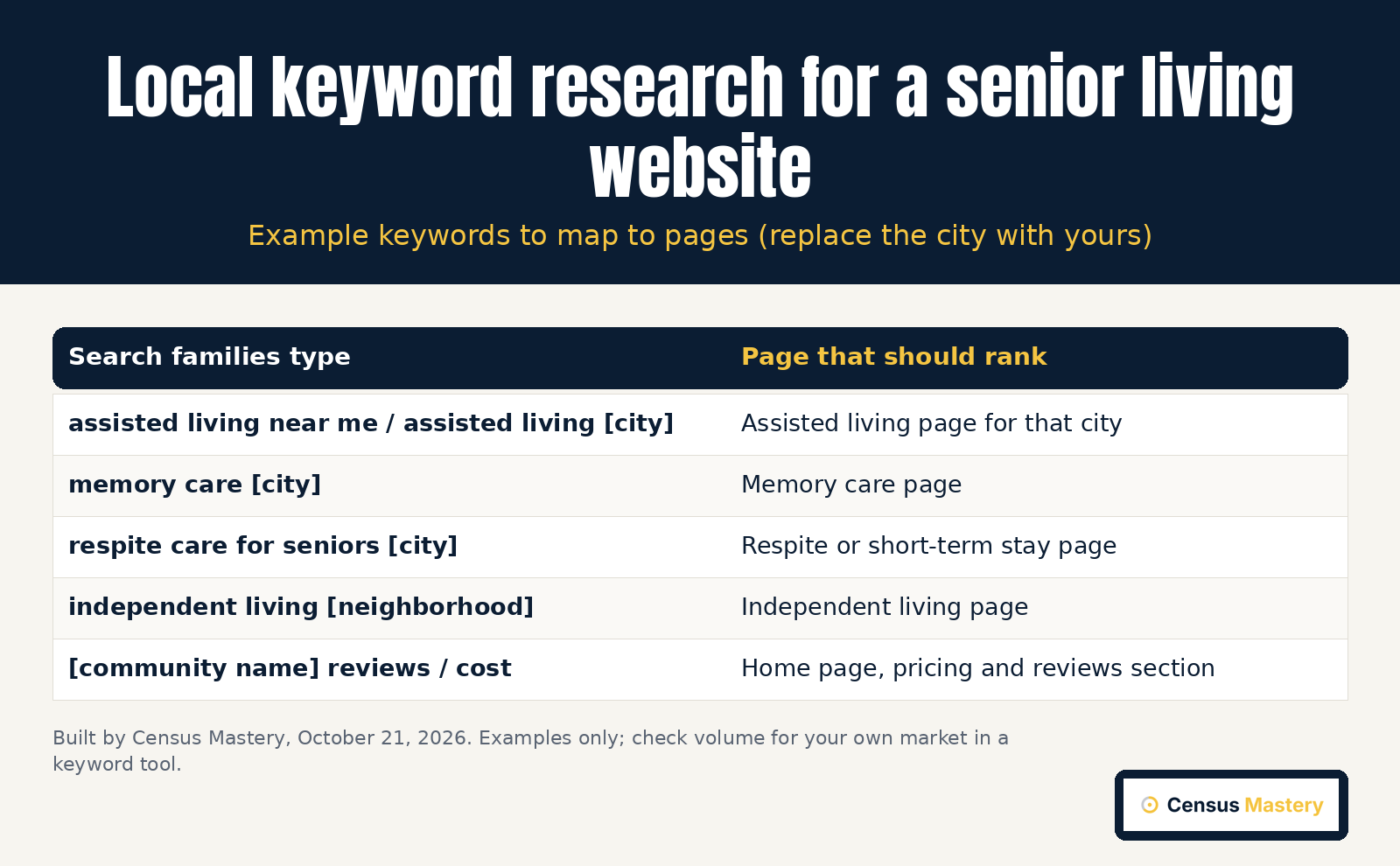
- Give each care type its own page: assisted living, memory care, independent living and respite.
- Name the city and nearby neighborhoods naturally in the title, meta description and first paragraph.
- Add details only you can give: room sizes, staff ratios you publish, the daily schedule, real photos.
- Link each page to your tour form, and track calls and form fills in Google Search and Google Analytics.
Technical SEO matters too, because a slow or broken page can drop on search engine results pages. Make pages fast on a phone, use one clear H1, keep meta titles under about 60 characters, and fix broken links. Good web design that loads fast helps families and search engine algorithms alike. Content marketing builds on this base: answer the questions families ask in blog posts, then link those posts to your care pages.
Step 5: Track your map rank across town
Your rank changes block by block. A family two miles north may see you first, while one three miles south sees a competitor. A geogrid scan shows where you win and lose.
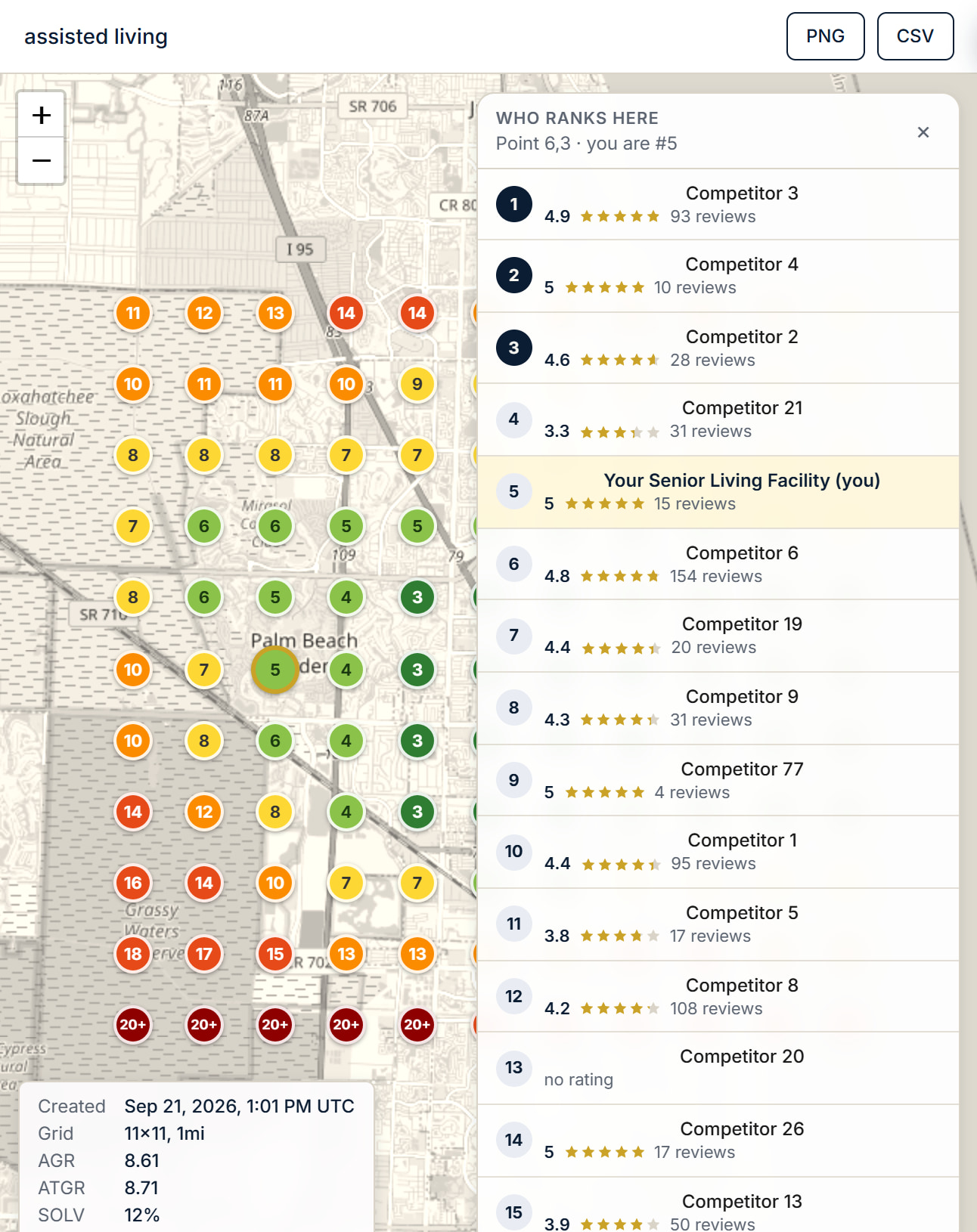
Check your local search rankings every month for your top three keywords. Small SEO improvements, like a new category or ten new reviews, can show up within weeks. When a competitor beats you in one area, look at their review count, categories and photos, then close the gap.
AI SEO: showing up when families ask ChatGPT
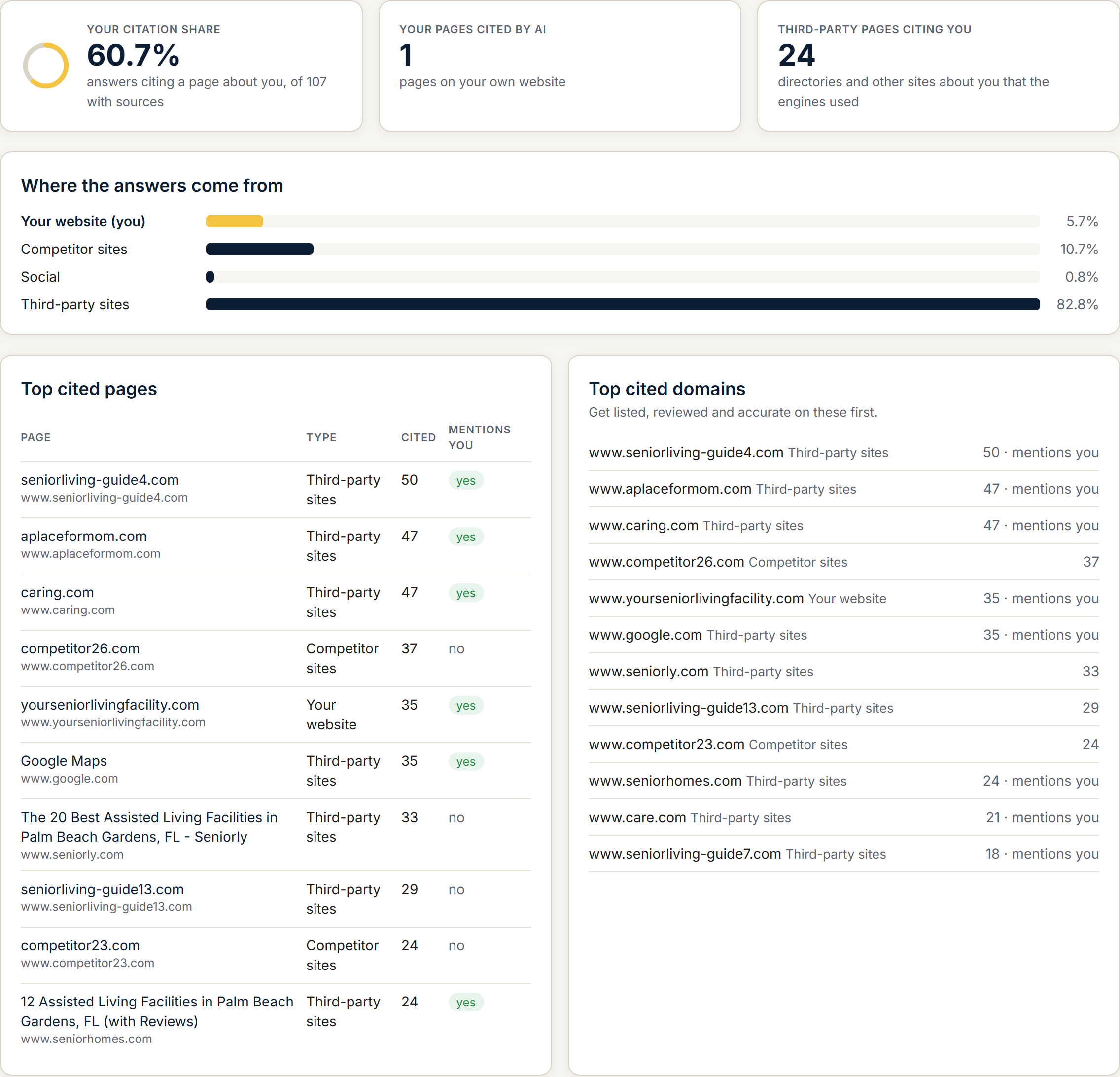
Families need answers fast, so many now ask ChatGPT, Gemini and Google's AI Mode for the best assisted living near a parent. AI answers lean on the same signals as Google Search: your profile, your reviews and the directories and pages that mention you.
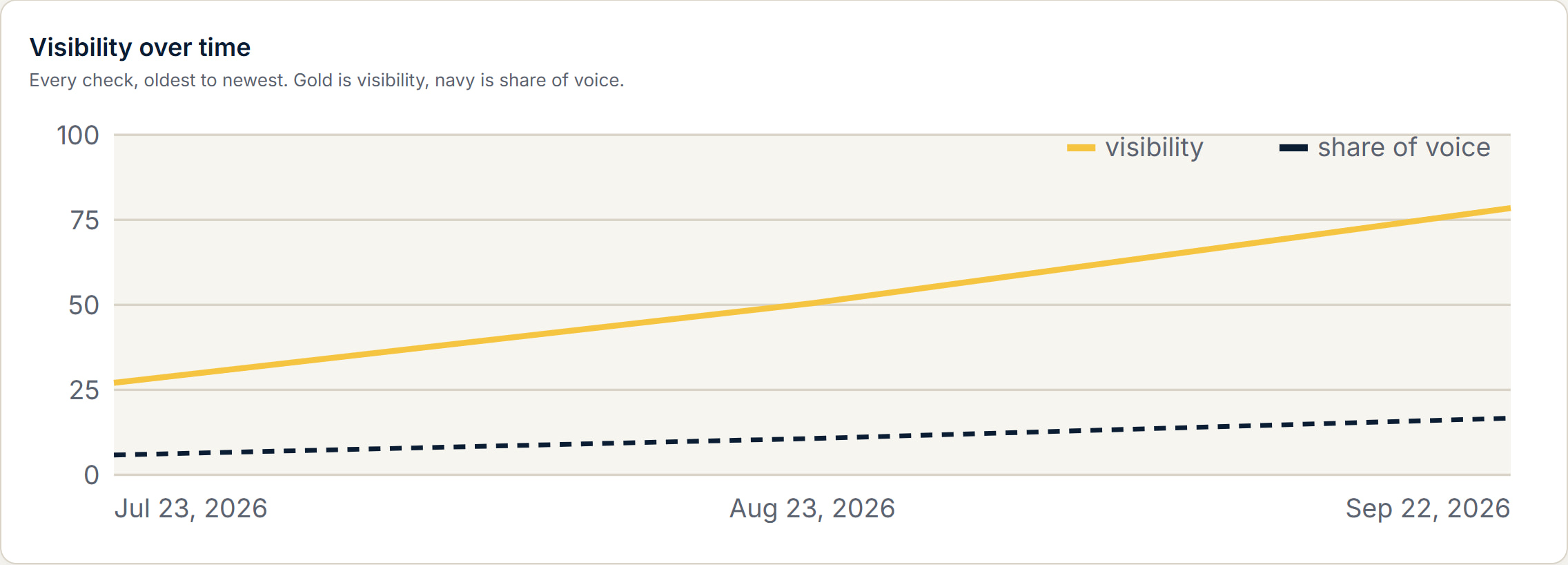
Track which prompts name you and which websites the AI engines cite. If directories are cited and your site is not, strengthen your pages and listings there first.
Senior living SEO company, SEO services or do the SEO work yourself?
Many senior living providers hire a digital marketing agency for SEO services, and the senior living industry has plenty of agencies with senior living clients. A good senior living SEO company can help with content and link building. Before you sign, ask what they will do each month, how they report qualified leads, and whether you own your profile and website. Some marketing agencies bundle SEO and PPC; ask for the split.
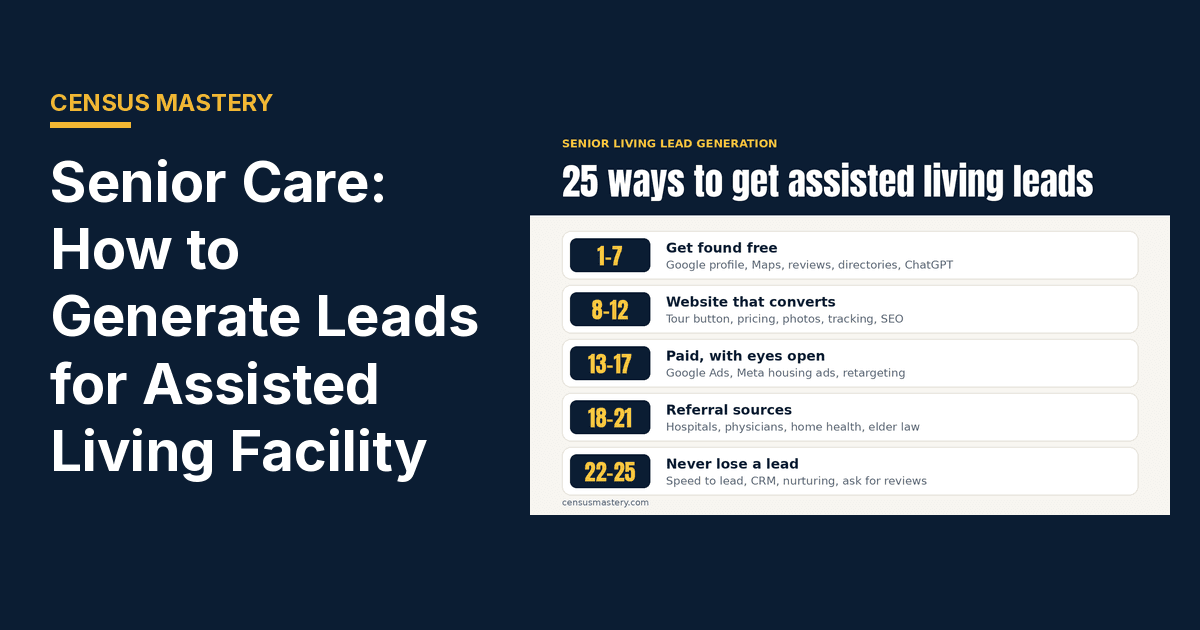
If you run one or two communities, you can do most of this yourself in a few hours a month with the right tools. Census Mastery tracks your Google Business Profile, map rank, reviews and AI search in one place, and every plan includes a senior living CRM for lead tracking so you can see which searches turn into tours. Our guides on how to generate leads for an assisted living facility and how to increase census in assisted living show what to do with those leads.
Senior living SEO strategy: frequently asked questions
These are the senior living SEO questions owners ask me most.
How long does local SEO take for an assisted living community?
Profile fixes and new reviews can move map rankings within weeks. Page and link work usually takes three to six months to show steady gains in search results.
What is the most important local ranking factor for senior living?
Your Google Business Profile, backed by reviews. That is the core of assisted living SEO. Google names relevance, distance and prominence as its main factors, and reviews feed prominence.
Do senior living directories help SEO?
Yes. Consistent directory listings support prominence, and AI engines often cite senior living directories when families ask for recommendations.
Should a senior living community use SEO and PPC together?
Paid ads can fill a gap while SEO builds. Over time, strong SEO efforts lower how much you need to spend on ads for each tour.
The bottom line
Local SEO for senior living is not complicated, but it has to be steady. Fix your Google Business Profile, ask every family for a review, keep your listings consistent, build a page for each care type and city, and track your rank every month.
Census Mastery comes with a guarantee. We guarantee a move-in. See the guarantee, then get your free Census Score on a 20-minute call.