How to Increase Census in Assisted Living: 21 Senior Care Plays That Boost Occupancy and Fill Beds
How to Increase Census in Assisted Living: 21 Senior Care Plays That Boost Occupancy and Fill Beds
You know the swing. Full in the spring, short by February, and clawing back by summer. I have spent years helping assisted living owners fill beds, and the communities that stay full are rarely the ones with the newest building. They are the ones a family trusts in the first ten minutes of searching.
This guide is the list I wish every owner had on the wall. Twenty-one plays, grouped by where the family is in their search, with real numbers behind them and no fluff. Some cost nothing, and none of them need a massive marketing budget. A few take a month of steady work. All of them move census in assisted living facilities of any size across the United States.
How to increase census in assisted living: the short answer
To increase census in assisted living, fix what families see on Google first, then answer every inquiry fast, follow up after every tour, and build steady referral sources. Keep the residents you already have, and staff the beds you want to fill. Most census problems are a trust problem that shows up before the phone ever rings.
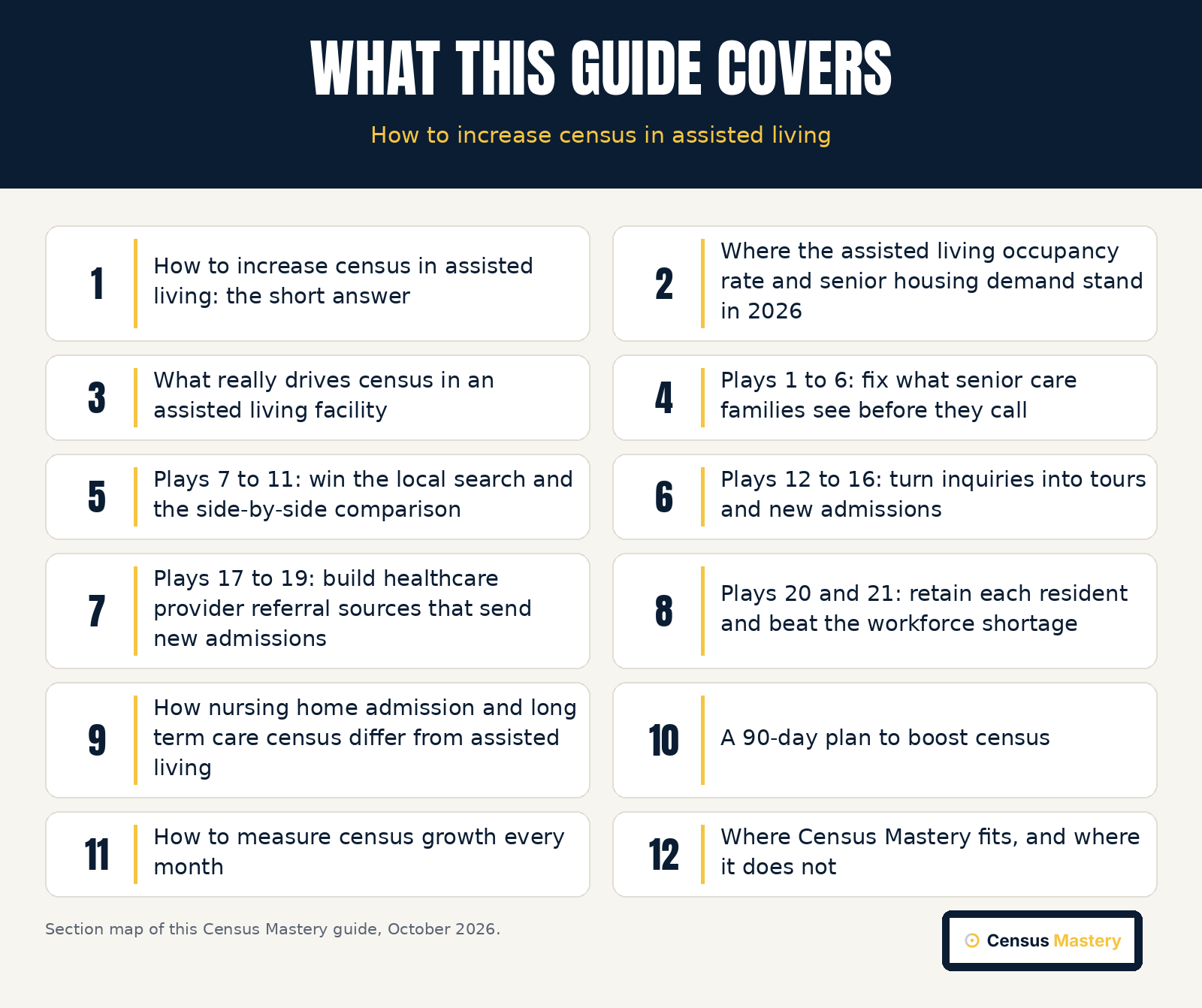
Here is the whole list in one place, so you can see where you are strong and where you are leaking families:
- Know your score before you spend a dollar
- Ask every family for a Google review
- Keep your newest review under 30 days old
- Reply to every review, safely
- Claim and fix your directory listings
- Show up when families ask ChatGPT
- Rank on Google Maps where families search
- Know your five real competitors
- Watch the up-and-comers and who is buying ads
- Make your website book tours
- Market what your reviews already say
- Answer every inquiry within minutes
- Put every inquiry in one pipeline
- Follow up after the tour, again and again
- Give a tour about the resident, not the building
- Talk about pricing early and hold your rate
- Earn hospital discharge planners and case managers
- Partner with skilled nursing and home health providers
- Help families find the money
- Reduce move-outs
- Staff the beds you want to fill
Where the assisted living occupancy rate and senior housing demand stand in 2026
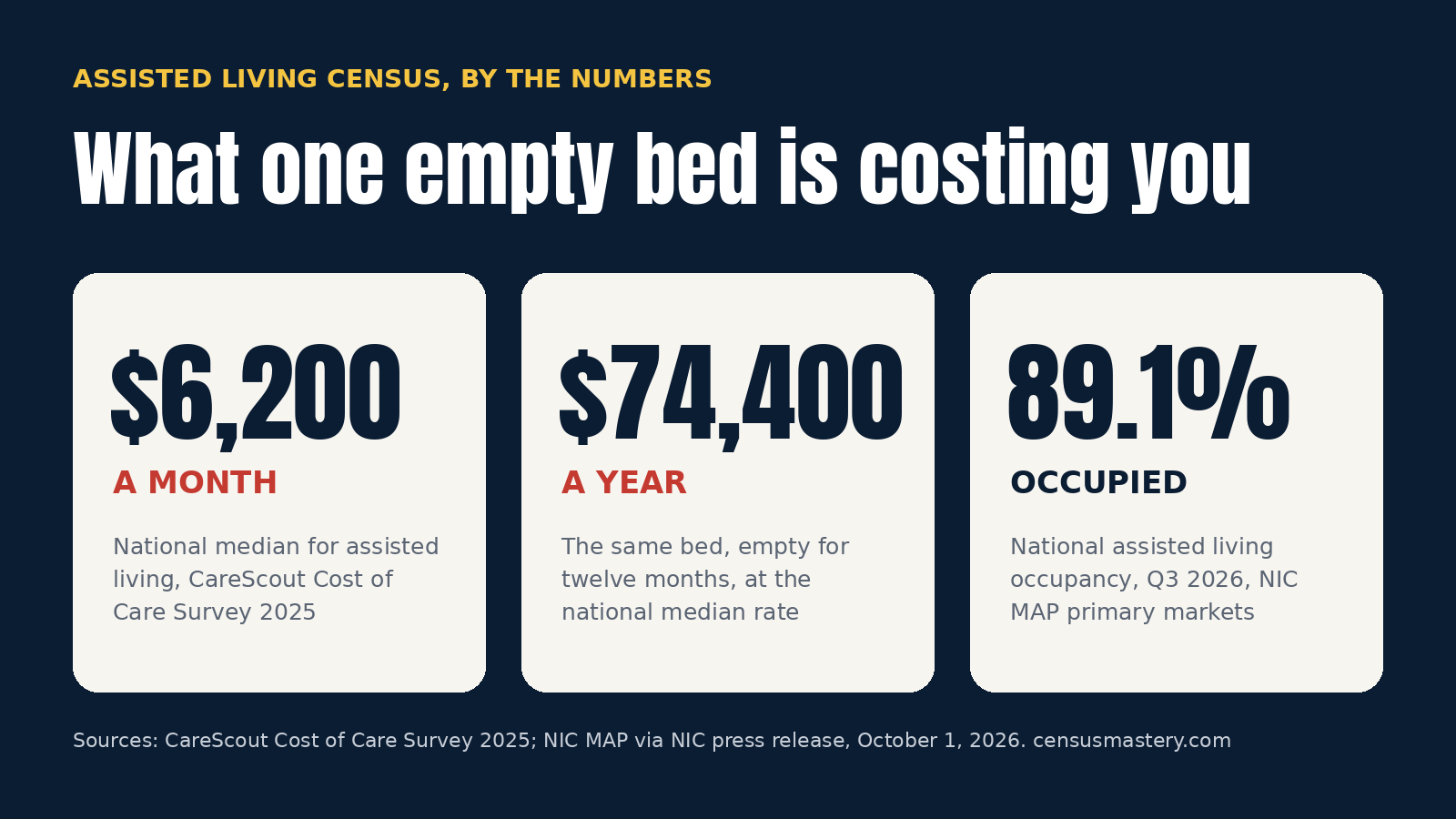
National assisted living occupancy was 89.1 percent in the third quarter of 2026, up from 88.3 percent the quarter before, according to NIC MAP data. Senior housing as a whole hit 90.4 percent. Demand is strong, so if your occupancy rate is well below that, the gap is usually local and fixable.
Those numbers come from the National Investment Center for Seniors Housing and Care release of October 1, 2026. It was the 21st straight quarter of occupancy gains across senior housing, and construction keeps falling behind what an aging population needs. NIC says holding occupancy at 90 percent would take more than 100,000 new units in most years through the late 2030s, against about 10,445 a year being built.
So why are so many owners still short? Because the averages hide a huge spread. Boston sat at 94.0 percent while Miami was at 86.5 percent in the same release. And the national numbers come from larger professionally managed communities in the 31 primary markets. A 10-bed home in a small town is fighting a different fight: two or three competitors, a few referral sources, and families who decide on their phone at night.
An empty bed is expensive. The national median for assisted living is $6,200 a month, or $74,400 a year, per CareScout's 2025 Cost of Care Survey. Two empty beds at that rate is roughly $148,800 a year walking out the door. If you want the full math for your own rate, our guide to the cost of an empty bed in assisted living walks through it.
What really drives census in an assisted living facility
Census in an assisted living facility comes down to three things: whether families trust you when they search, how fast and how well your staff turns an inquiry into a tour and an admission, and how long residents stay. Referral sources matter, but even a referred family checks Google before they call you.
A daughter gets your name from a hospital case manager. Before she calls, she searches. She sees your rating, how many reviews you have, and the date of the last one. Then she looks at the community down the road. By the time she picks up the phone, she has a short list, and you may not be on it.
The research backs this up. The BrightLocal Local Consumer Review Survey 2026 found 97 percent of consumers read reviews before choosing a local business, 47 percent will not consider a business with fewer than 20 reviews, and 31 percent will not consider one under 4.5 stars. Families choosing care for their loved ones are not less careful than people choosing a plumber. They are more careful. That is true across senior care, from nursing homes and assisted living communities to other long term care facilities, and it is true in every part of health care where trust decides the choice.
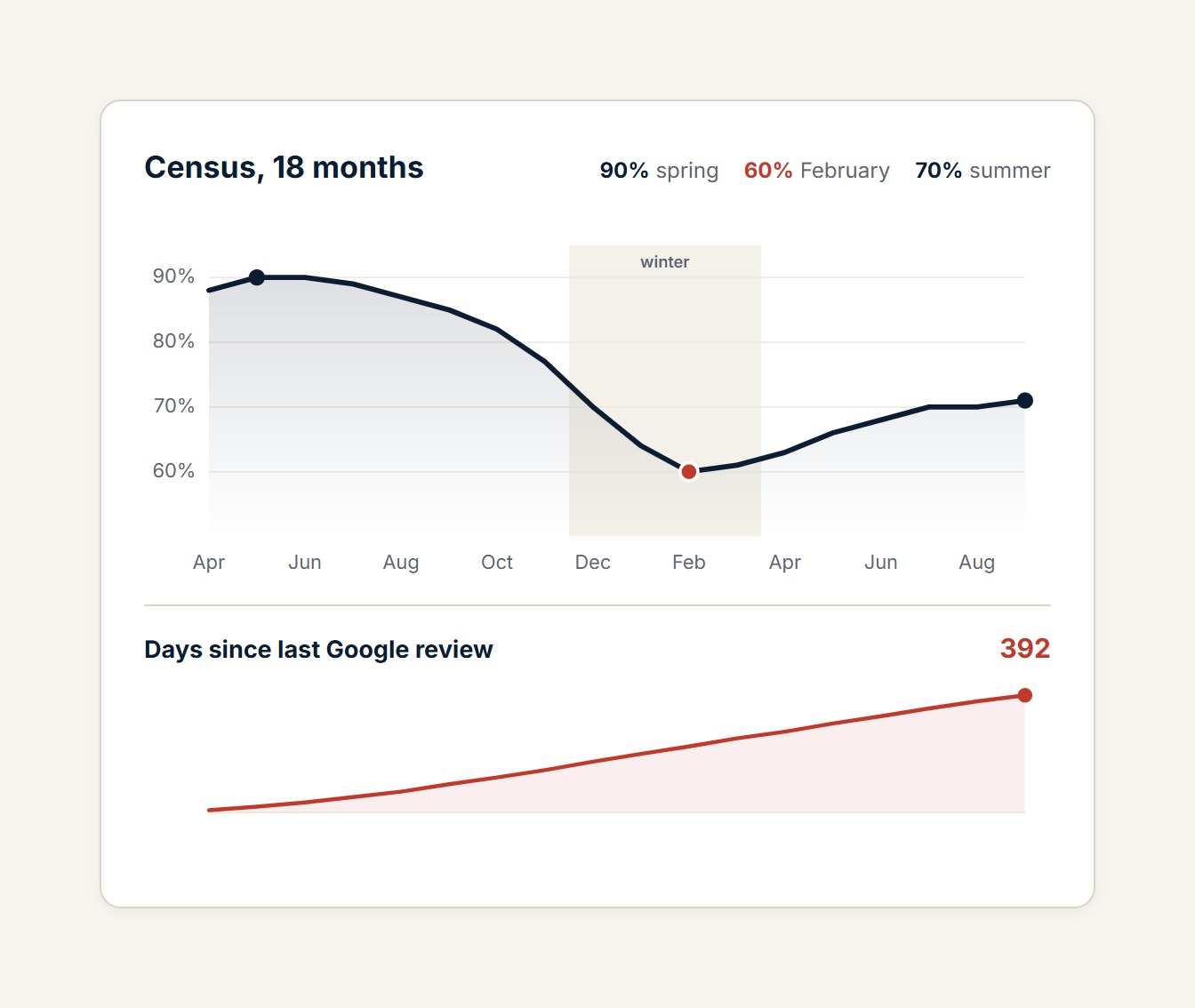
Look at that chart. The census drop and the stale review line move together. That is not a coincidence I see once. I see it all the time.
Plays 1 to 6: fix what senior care families see before they call
The fastest way to boost census is to fix what families find when they search your name. Your Google rating, review count, review freshness, replies and directory listings are the first impression for every senior and family member looking at care, long before they talk to your staff or walk your halls.
1. Know your score before you spend a dollar
Most owners guess at their reputation. Guessing is how you spend money in the wrong place. Start with a full audit of every place a family can find you: Google, Apple Maps, Yelp, Facebook, and senior directories like A Place for Mom, Caring.com and Seniorly. Write down your rating, review count and newest review date on each one, and do the same for the three communities you lose families to.
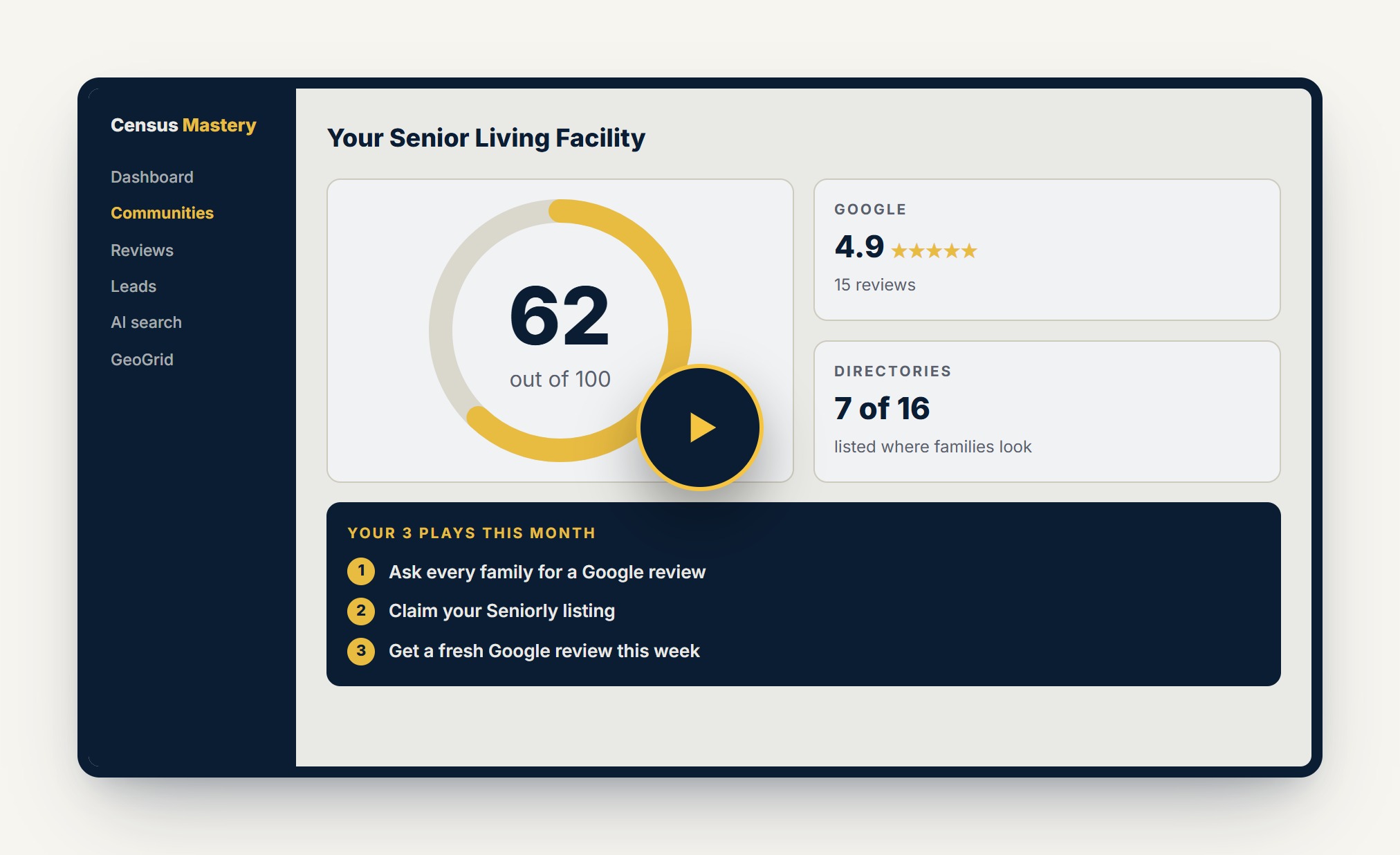
Our Census Score does exactly this, out of 100, and you can see how senior living reputation management works. The checks are on our senior living reputation management page. Whatever you use, the point is a number you can move and a short list of what to fix first.
2. Ask every family for a Google review
Not the happy ones. Every family. Asking only the families you think will leave five stars is called review gating, Google does not allow it, and it tends to backfire anyway. Ask every resident's family at the same moments: 30 days after move-in, after a care plan meeting that went well, and when a family thanks a staff member.
Make it easy. A short text with your review link, a QR card at the front desk, and a line in your monthly family email. Our guide on how to get more Google reviews for assisted living has the scripts.
3. Keep your newest review under 30 days old
BrightLocal found 32 percent of consumers want to see a review from the last two weeks. A community whose newest review is a year old looks closed, even if every bed is full of happy residents. A steady trickle of two or three reviews a month beats twenty in one week and then nothing. Read more about review recency.
4. Reply to every review, safely
Families read your replies as closely as the reviews. Thank people by first name, keep it short, and never confirm that someone is or was a resident. That last part matters because of HIPAA. "Thank you for trusting us with your mom" confirms residency in public. "Thank you for taking the time to share this" does not. For negative reviews, acknowledge, take it offline, and give a name and number. Our guide to HIPAA compliant review responses has safe templates.
5. Claim and fix your directory listings
Families use about six review sites on average when choosing a local business, per BrightLocal. If Seniorly lists your three competitors and not you, you are out of the running for that family. Claim every senior directory listing, match your name, address and phone exactly to your Google profile, and add real photos. Start with our list of senior living directories.
6. Show up when families ask ChatGPT
BrightLocal's 2026 survey found 45 percent of consumers now use AI tools like ChatGPT for local business recommendations, up from 6 percent a year earlier. Those tools lean on your reviews, your listings and your website. Ask ChatGPT for the best assisted living in your town and see if you come up. If not, here is how to show up in ChatGPT as an assisted living community.
Plays 7 to 11: win the local search and the side-by-side comparison
Families compare you to the two or three other communities they toured that week, not to a national average. Winning that comparison means ranking on Google Maps where families search, knowing exactly what your competitors look like online, and making your website and your message do the selling for you.
7. Rank on Google Maps where families search
Your Google Business Profile is your real front door. Use the right primary category, list every service, post weekly, add fresh photos and answer questions. Then check where you rank across your whole area, not just at your front door. A community can be number one on its own street and number 15 two miles away, where half the families live.
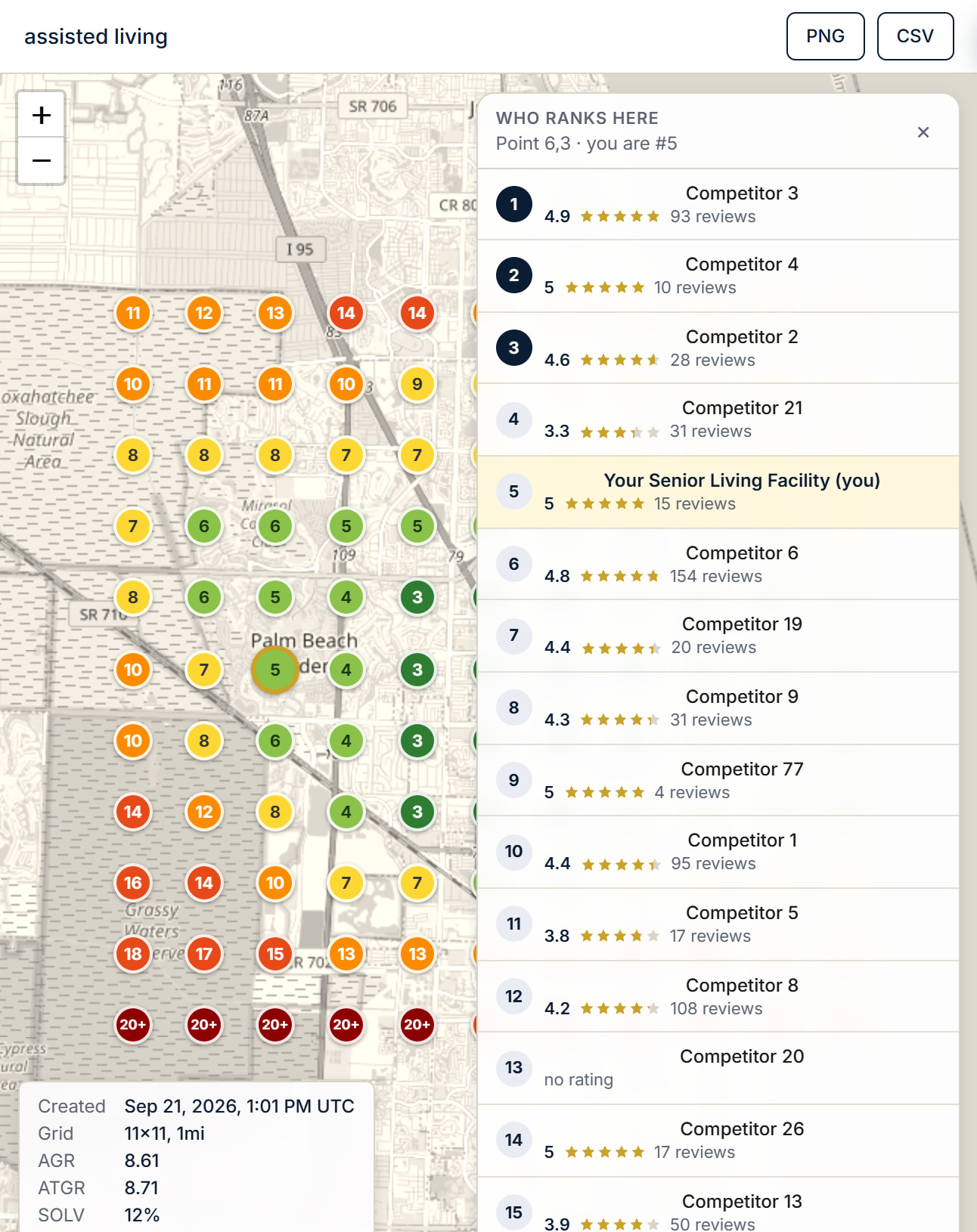
The full playbook is in how to rank higher on Google Maps for assisted living.
8. Know your five real competitors
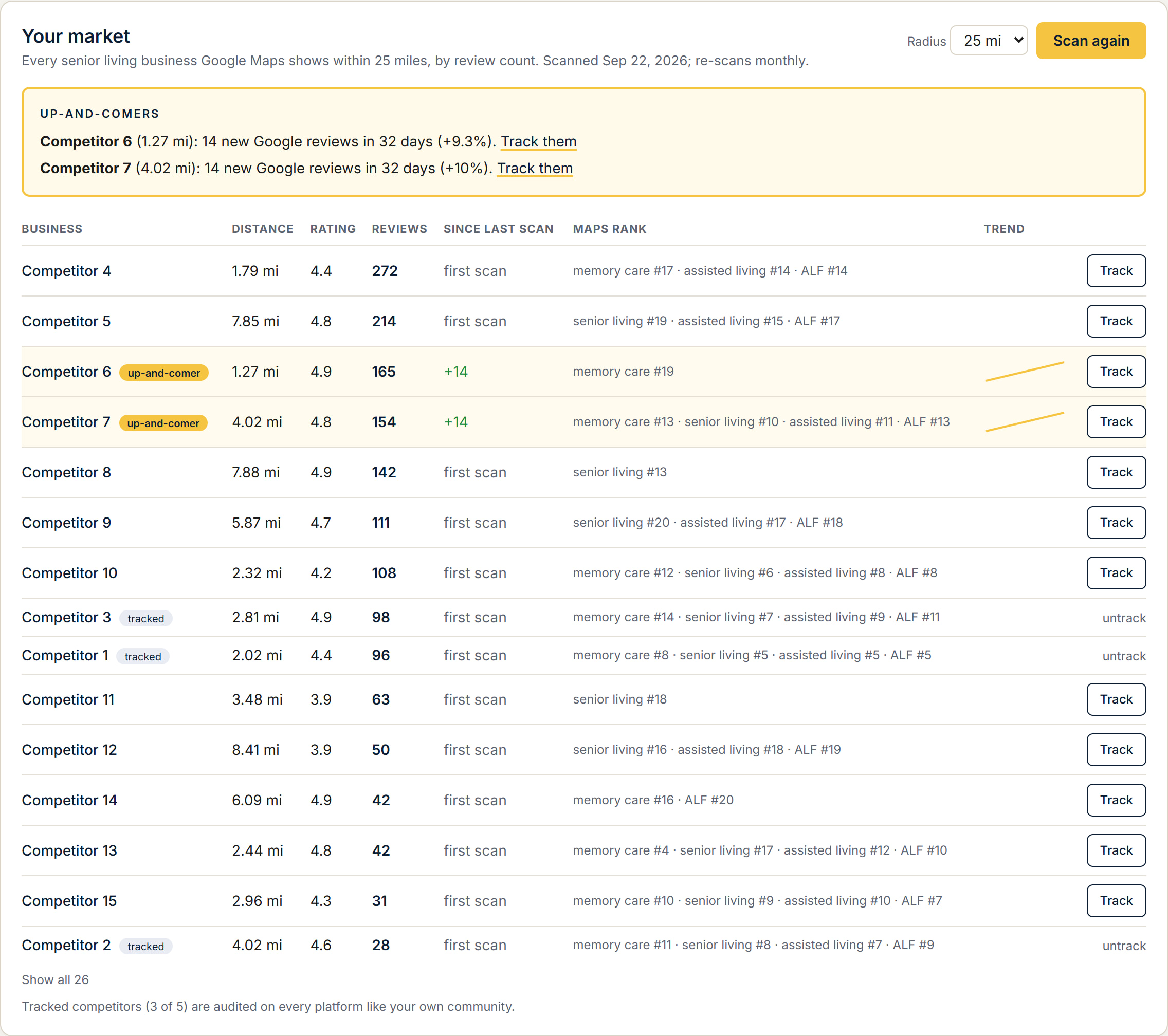
Not the ones you think you compete with. The ones Google shows when a family searches your care type in your town. Compare ratings, review counts, newest review dates and directory coverage side by side. "Competitor 1 has 96 Google reviews and you have 18" is the kind of sentence that gets an owner and a staff meeting moving. Our senior living competitor analysis builds that table for you.
9. Watch the up-and-comers and who is buying ads
The new memory care across town will take families before your referral sources even mention it. Scan your market monthly. Who added ten or more reviews last month? Who just moved into the Maps top five? Who is paying for ads in your market, including Google Ads on your name? You cannot react to what you cannot see.
10. Make your website book tours
Your website has one job: get a family to call or book a tour. Put your phone number at the top of every page, a tour button above the fold, real photos of real rooms, your reviews on the page, and a plain answer to "what does it cost to live here." Track every call and form with website tracking for senior living so you know which marketing campaign actually works. See our guide to an assisted living website.
11. Market what your reviews already say
Read your last 50 reviews and count what families mention: staff, food, activities, cleanliness, safety. If families keep praising your activities director and your competitor has none of those mentions, that is your marketing message. You did not have to invent it. Your residents and their families already wrote it.
Plays 12 to 16: turn inquiries into tours and new admissions
Most communities do not have a lead problem as much as a follow-up problem. Inquiries come in and sit. Tours happen and nobody calls back. Tightening the path from first call to admission is often the cheapest census boost an assisted living community has, because you already paid for those leads.
12. Answer every inquiry within minutes
A family in crisis calls three communities. The one that answers, or calls back first, usually gets the tour. Set a rule that every inquiry gets a live response within minutes during business hours and first thing the next morning after hours. Our guide to speed to lead in senior living covers the details.
13. Put every inquiry in one pipeline
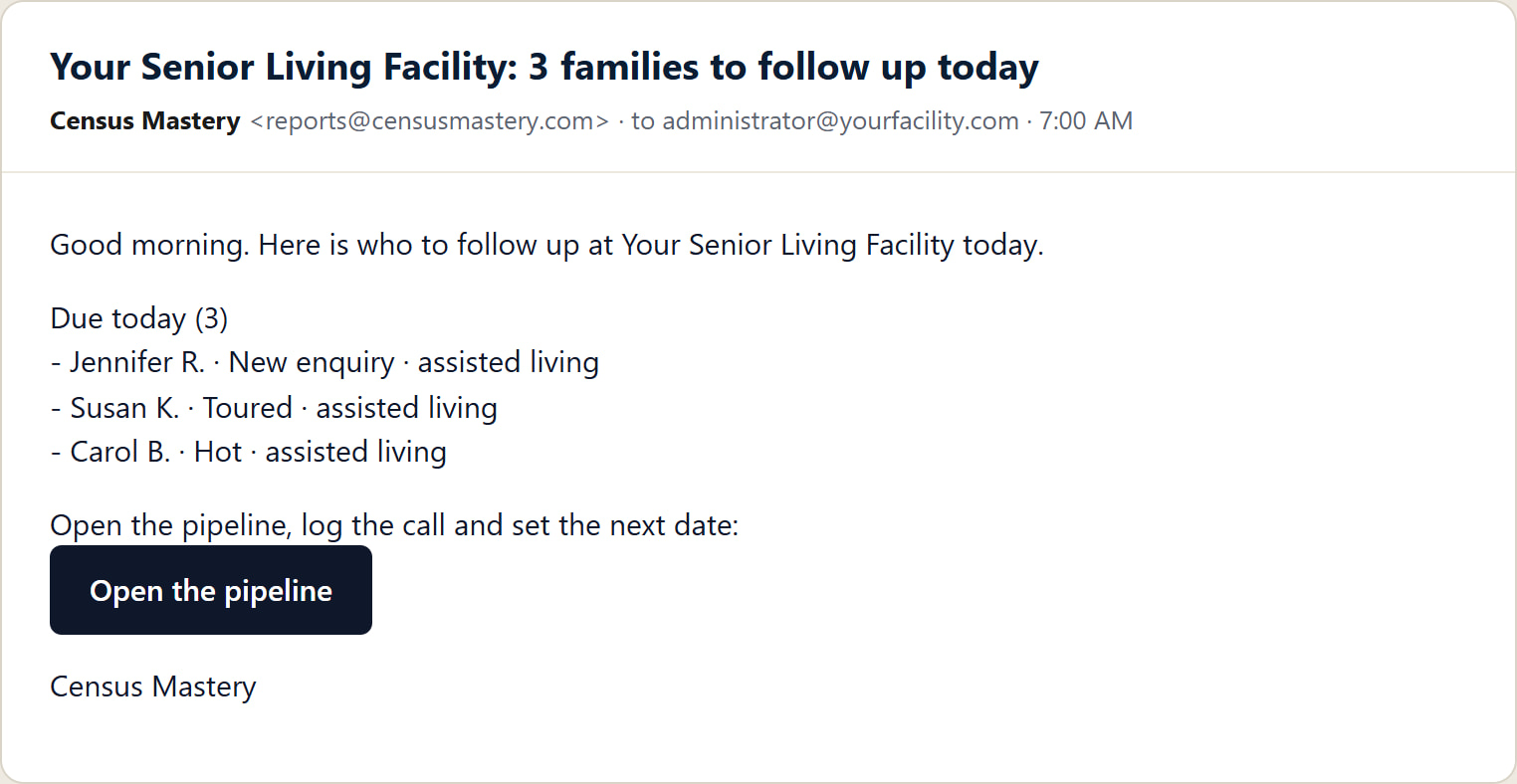
Sticky notes and a shared inbox lose families. Document every call, and let technology do the remembering. Every inquiry, from every source, goes into one senior living CRM with a stage, a next step and a date: new, contacted, tour booked, toured, deposit, moved in. Our senior living CRM guide explains how to choose one. Look at it every morning on a simple dashboard. A data-driven sales routine is not complicated. It is just consistent.
14. Follow up after the tour, again and again
What if a family tours, loves it, and your team gets busy and never calls back? It happens every week in this industry. Plan at least six or seven touches over a few weeks: a thank-you the same day, a call in two days, a handwritten note, an invite to lunch or an event, a check-in after the family meeting. Most decisions take longer than one call, so write the followup plan down and give each step an owner.
15. Give a tour about the resident, not the building
Families do not buy square footage. They buy confidence that mom will be safe and happy. Before the tour, ask about her day, her care needs, what she loves and what worries them. Then show the parts of the community that answer those worries, and demonstrate how staff respond when a call light goes on. Introduce the caregiver who would work her hall. Read how to give an assisted living tour for a full script.
16. Talk about pricing early and hold your rate
Families want a straight answer on cost. Give a clear starting price and explain levels of care on the first call. Be careful with discounts, though. At a NIC conference panel on building back occupancy, breakout groups concluded that rate concessions do not work and hurt long-term operating income. A move-in special can help a slow month. A permanent discount just lowers your ceiling.
Plays 17 to 19: build healthcare provider referral sources that send new admissions
Referral sources like hospitals, skilled nursing facilities, physicians and home health agencies can send a steady flow of new admissions, but only if they trust your community and find you easy to work with. The goal is to become the place a busy case manager thinks of first when a patient cannot go home alone.
17. Earn hospital discharge planners and case managers
Discharge planners and case managers need one thing: a fast, clear yes or no. Tell them what levels of care you accept, how fast you can assess, and who to call. Show up with something useful, not donuts alone. Follow up on every referral, even the ones that did not move in. Good outreach is how you cultivate trust with referral sources over months, not a single visit. Our guide to discharge planner referrals for assisted living goes deeper.
18. Partner with skilled nursing and home health providers
Many assisted living residents come after a short-term rehab stay in a skilled nursing facility. Others come when home health or home care is no longer enough. Build relationships with the admissions and social work staff at nearby nursing homes and post-acute care providers, and with physician offices that treat older adults with chronic conditions. A regular check-in call keeps you top of mind. More ideas are in our list of senior living referral sources.
19. Help families find the money
Cost stops a lot of move-ins that should happen. Know the options well enough to point families in the right direction: long-term care insurance, veterans benefits, and your state's Medicaid waiver program if you accept it. For example, the VA Aid and Attendance benefit adds a monthly payment to a VA pension for qualified veterans and survivors who need help with daily activities. A family that does not know a benefit exists cannot use it.
Plays 20 and 21: retain each resident and beat the workforce shortage
Census is not only move-ins. Every move-out you prevent is a bed you do not have to fill, and every bed you cannot staff is a bed you cannot sell. Retention and the workforce are the two census levers owners forget, and both affect quality of care and quality of life.
20. Reduce move-outs
Some move-outs are not preventable. Many are. Catch problems early with a quick satisfaction survey or a care plan check-in, and call any family that scores you low the same week. Fix the small irritations before they become a 30-day notice. Resident engagement, fall prevention and a consistent caregiver all help you retain residents longer. Our guide on how to reduce move-outs in assisted living has ten retention plays.
21. Staff the beds you want to fill
The labor shortage limits census as much as marketing does. In a 2021 American Health Care Association and NCAL survey during the COVID-19 pandemic, 58 percent of nursing homes said they were limiting new admissions because of staffing shortages, and 96 percent of assisted living providers reported a shortage. Every worker you keep is quality care you can promise the next family, and the whole care industry is competing for the same people. Culture is part of your marketing strategy here, because staff who like working for you stay. Recruit like you market: post jobs everywhere, pay your best caregivers to refer friends, and keep the staff you have.
How nursing home admission and long term care census differ from assisted living
Long term care census in a nursing home or skilled nursing facility depends heavily on hospital referrals, Medicare and Medicaid, and clinical quality measures. Assisted living census leans more on private-pay families searching online and touring. Both share the same basics: reputation, fast response, strong referral sources and enough staff, but the mix and the healthcare paperwork are different.
A skilled nursing facility lives and dies by its hospital relationships and its short-term rehab admissions. Families still search and read reviews, but the case manager often has more say. An assisted living community is usually chosen by an adult child after weeks of research, so the Google search, the tour and the follow-up carry more weight. If you run a nursing home, our guide on how to build census in a nursing home is the better fit. For memory care, see how to increase census in memory care.
A 90-day plan to boost census
A 90-day plan works because it puts the cheapest, fastest fixes first. Spend month one on your reputation and listings, month two on your inquiry and tour follow-up, and month three on referral sources and retention. Measure your occupancy rate, inquiries, tours and move-ins every week so you can see what is working.
Days 1 to 30. Run your audit. Start asking every family for a review. Reply to every review on Google and the directories. Claim missing listings. Fix your Google Business Profile.
Days 31 to 60. Set your speed-to-lead rule. Move every inquiry into one pipeline. Write your tour follow-up plan and assign it. Update your website with reviews, real photos and a tour button.
Days 61 to 90. Visit your top five referral sources. Start a monthly check-in with each. Run a family satisfaction check and call every low score. Review staffing for the beds you plan to fill.
If your census is already in trouble, our census recovery plan for assisted living breaks this into week-by-week steps.
How to measure census growth every month
Track a small set of numbers every month: occupancy rate, inquiries by source, inquiry-to-tour rate, tour-to-move-in rate, move-outs and their reasons, average days to fill a bed, Google rating and review count against competitors. Those numbers tell you exactly which play to run next, instead of guessing.
Keep it on one page. Tracked accurately, these numbers inform your budget allocation and show which channel brings in revenue. If inquiries are fine but tours are low, the problem is your phone answering or your website. If tours are fine but move-ins are low, it is your tour or your follow-up. If move-ins are fine but census is flat, look at move-outs. If inquiries are low, go back to plays 1 to 11. Our assisted living census report lists 12 KPIs with simple formulas.
Where Census Mastery fits, and where it does not
Census Mastery covers plays 1 through 11 and the pipeline in play 13: it scores your reputation, compares you with five competitors, tracks Google Maps rank and AI visibility, and sends your review requests. It does not run tours, call discharge planners or hire caregivers. Those plays are still on you.
I built it because I kept watching good communities lose families to worse ones with better Google pages. It is software made only for senior living, from $79 a month, with a 30-day money-back guarantee. The Full Census and Waitlist plans come with a move-in guarantee: at least one move-in, or you get Census Mastery free for life plus 6 months of marketing worth US$12,000. Terms apply.

To be honest about the gaps: it has no phone system, no webchat, no payments and no human team replying for you. It is not a full care-management system and it does not connect to your billing software. If you need those, you will want other tools beside it. On the plus side, there is no integration project and no long adoption period: signing up takes about two minutes and the first audit runs within about ten.
"Absolutely reliable reporting and extremely detailed insights. Ronald's team and tools have helped us maintain a census over 90 percent for five years." That is Daniel Lowry, President of Sunny Hills Assisted Living in Florida.
If you want to see where your community stands, start with your free Census Score. It takes about 20 minutes on a call, and the report is yours whether you sign up or not.
Frequently asked questions about assisted living census
These are the questions owners ask me most about how to increase census, occupancy rates and referral services. Short answers here, with links to deeper guides where a question needs more room. If your question is not here, the census and lead generation guides on this blog cover most of the rest.
What is the ideal senior living occupancy rate? There is no single ideal number, but many operators treat 90 percent or higher as healthy. National assisted living occupancy was 89.1 percent in Q3 2026 per NIC MAP. Your break-even depends on your rates and staffing, so know your own number. See assisted living occupancy rates.
How long does it take to see results from occupancy strategies? Reputation fixes like new reviews and claimed listings can show in weeks. Better follow-up can lift move-ins within one or two months. Referral relationships usually take three to six months to produce steady admissions.
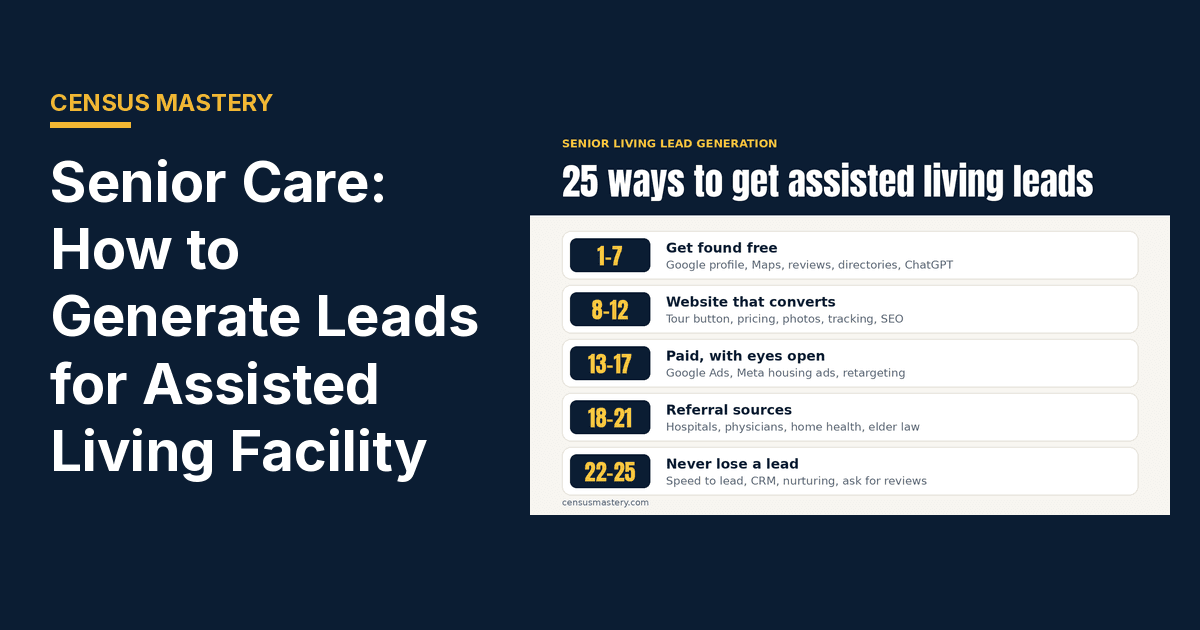
How can senior living communities generate leads without a large marketing budget? Start with free channels: Google reviews, your Google Business Profile, directory listings and referral sources. Then fix follow-up, which costs nothing. Our guide on how to generate leads for an assisted living facility has 25 ideas.
What is the 80/20 rule in senior living communities? People use it loosely to mean most move-ins come from a small share of your sources. Check your own pipeline. If most move-ins come from two referral sources and Google, protect and grow those first.
How does A Place for Mom work? A Place for Mom is free for families. Per its own site, it is paid by participating communities when a family it referred moves in. It is a referral service, so many owners use it beside their own marketing rather than instead of it. See senior living referral fees. Compare A Place for Mom alternatives if you want fewer of those fees, and see how much A Place for Mom charges before you renew.
Why are so many skilled nursing facilities still struggling with census growth? Staffing limits, changing hospital referral patterns and payer mix all play a part. The 2021 AHCA/NCAL survey found most nursing homes limiting admissions due to the workforce shortage. Fixing staffing and hospital relationships usually comes before marketing.
How long does it take for someone to adjust to assisted living? It varies a lot. Many families say the first few weeks are the hardest and things settle within a few months. A warm welcome, a consistent caregiver and regular updates for loved ones help, and they also reduce early move-outs.
Keep reading: get a free senior living competitor analysis and senior living review software. See census management software, the best senior living census software roundup and how to market an assisted living facility.